
On Wednesday 12th August 2026, people across the UK will witness the biggest solar eclipse visible here since 1999. Depending on where you are, the Moon will cover around 90–96% of the Sun, creating an unforgettable sight.
If you’ve left it too late to buy eclipse glasses, don’t panic! There are still plenty of brilliant (and completely safe) ways to enjoy this spectacular event.
The most important thing to remember is this:
Never look directly at the Sun without proper eye protection.
Even when most of the Sun is covered by the Moon, its remaining light is still powerful enough to cause permanent eye damage. Unlike a total eclipse, there is never a safe moment to look directly at the Sun during the UK’s partial eclipse.
Here are our favourite safe ways to enjoy eclipse day.
1. Use Certified Eclipse Glasses ⭐
If you’ve already got a pair, check they’re genuine before using them.
Safe eclipse glasses should:
- Meet the ISO 12312-2:2015 international safety standard
- Be free from scratches, tears or damage
- Come from a reputable supplier
Remember:
- ❌ Regular sunglasses are not safe.
- ❌ 3D cinema glasses are not safe.
- ❌ Homemade tinted plastic or smoked glass are not safe.
If your glasses are damaged or you’re unsure whether they’re genuine, don’t risk using them.
2. Make a Simple Pinhole Projector
One of the easiest (and most fun) ways to watch the eclipse is to project an image of the Sun instead of looking at it.
You’ll need:
- Two sheets of white paper or card
- A pin
Simply make a tiny hole in one sheet of card, stand with your back to the Sun and let the sunlight shine through onto the second sheet.
You’ll see a tiny image of the Sun—and as the eclipse progresses, you’ll notice a little “bite” appearing in it!
It’s a fantastic science activity for children too.
3. Grab a Colander from the Kitchen
Yes, really!
The hundreds of tiny holes in a kitchen colander act like lots of miniature pinhole projectors.
Hold the colander so sunlight shines through onto the ground or a sheet of paper and you’ll see dozens of tiny Suns projected underneath.
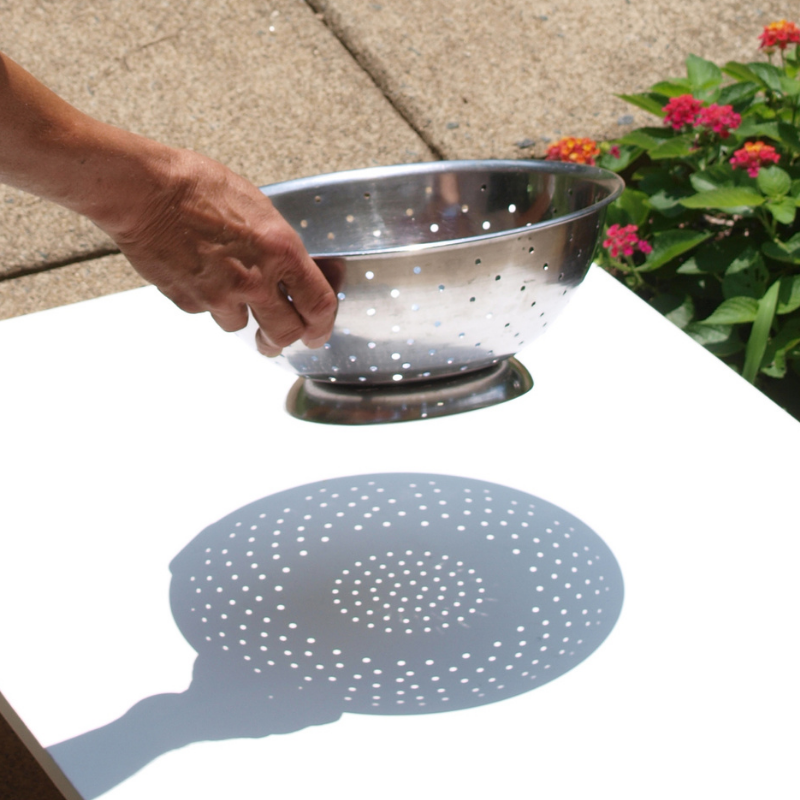
As the Moon moves across the Sun, every little image changes shape.
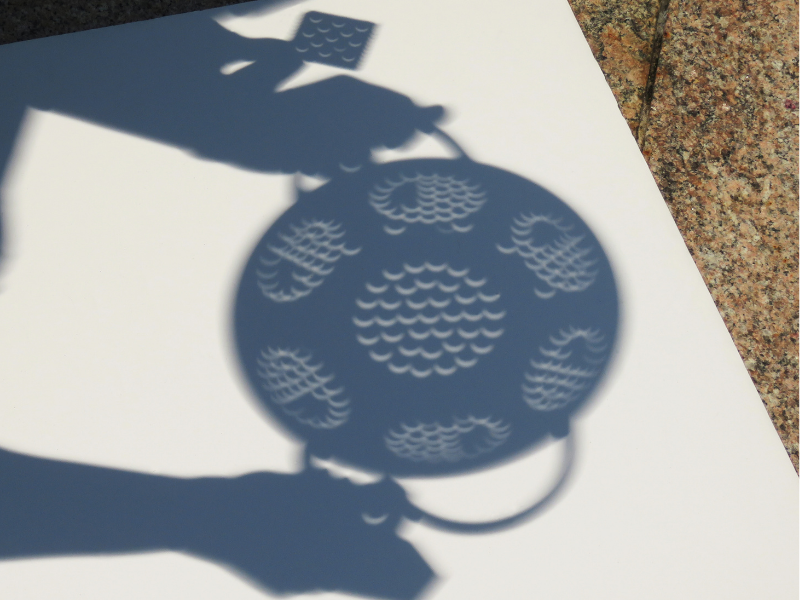
It’s one of the easiest ways to view the eclipse (and bonus – there’s no complicated crafting required!)
4. Look Beneath the Trees
Nature has already made thousands of pinhole projectors.
The tiny gaps between leaves allow sunlight through, creating hundreds of miniature images of the Sun on the ground.
During a solar eclipse those little circles transform into tiny crescents.
Take a walk beneath a leafy tree during the eclipse and have a look—you might be surprised by what you find!
5. Watch a Live Stream
Cloudy skies? No problem.
The Royal Observatory Greenwich will be broadcasting the eclipse live online using professional solar telescopes, with astronomers explaining exactly what’s happening as the Moon passes across the Sun.
It’s completely free and a brilliant option if the British weather doesn’t cooperate.
6. Visit a Local Astronomy Group
Many local astronomy clubs and observatories hold public viewing events during eclipses.
They often provide:
- Special solar telescopes
- Expert guidance
- Safe viewing equipment
- Family-friendly activities
It’s a fantastic opportunity to learn more about our nearest star while seeing the eclipse through equipment that’s specially designed for observing the Sun safely.
7. Can’t Wait? Watch a Solar Eclipse Simulation
This video is a realistic 3D simulation of a solar eclipse – no glasses, no special weather conditions and absolutely no patience required! This could be the perfect solution if the eclipse is a little too late, subtle or slow for a young child who wants to see what happens during a solar eclipse.
Things You Should Never Do
However tempting it might be, never:
- ❌ Look directly at the Sun without proper protection
- ❌ Use sunglasses instead of eclipse glasses
- ❌ Look through binoculars or a telescope without a certified solar filter fitted to the front of the instrument
- ❌ Look through a camera lens while wearing eclipse glasses
These can all cause serious, permanent eye damage.
Make It a Family Science Challenge
Why not turn eclipse day into a mini science investigation?
Try comparing:
- Which method gives the clearest image?
- Does a metal colander work better than a plastic one?
- How does the projected image change every 10 minutes?
- Can you spot crescent-shaped patches of light beneath different trees?
It’s a wonderful opportunity to combine astronomy, observation and a little scientific curiosity.
Don’t Miss This Once-in-a-Generation Event!
The August 12th eclipse will be the most impressive solar eclipse visible from the UK since 1999, and there won’t be another one this dramatic for decades. Find out exactly what to expect from your location – and what time you will see the 2026 solar eclipse – here.
Whether you’re using eclipse glasses, a homemade projector or simply watching online, there are plenty of safe ways to experience one of nature’s most spectacular shows.
Let’s keep our fingers crossed for clear skies! 🌞🌙