
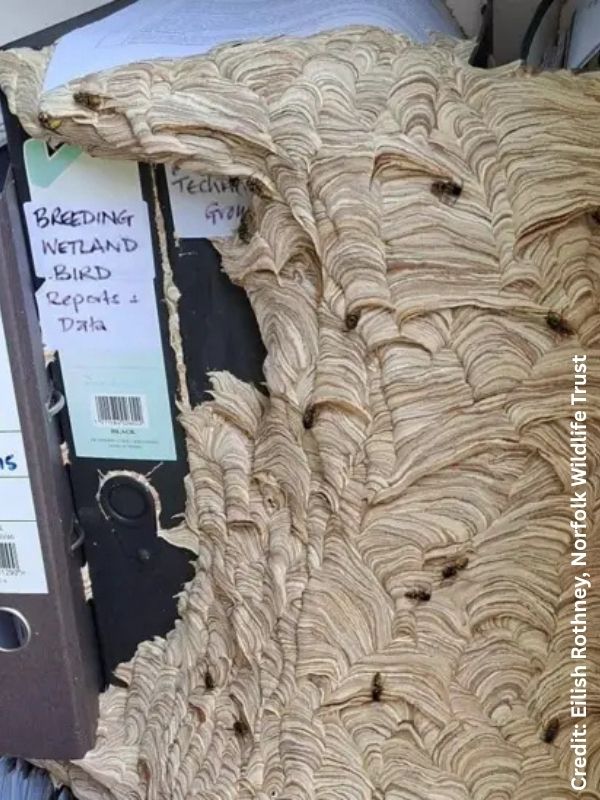
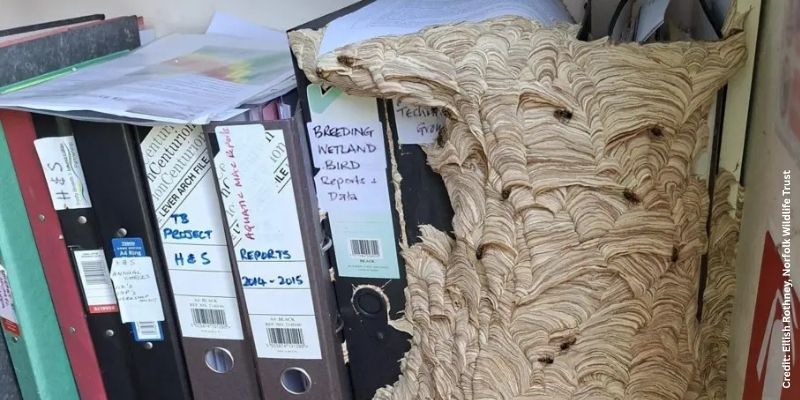
Imagine going back to work after a few weeks away, only to discover that thousands of wasps have moved into your office!
That’s exactly what happened to Eilish Rothney, a nature reserve manager at the Norfolk Wildlife Trust. While she was busy carrying out wildlife surveys, a colony of wasps quietly built an enormous nest around a bookshelf inside her office.
By the time she returned, the nest had grown to around one metre tall and wrapped itself around boxes, shelves and ring binders.
Instead of trying to destroy it, Eilish decided to let the wasps carry on with their important work.
A paper-like masterpiece
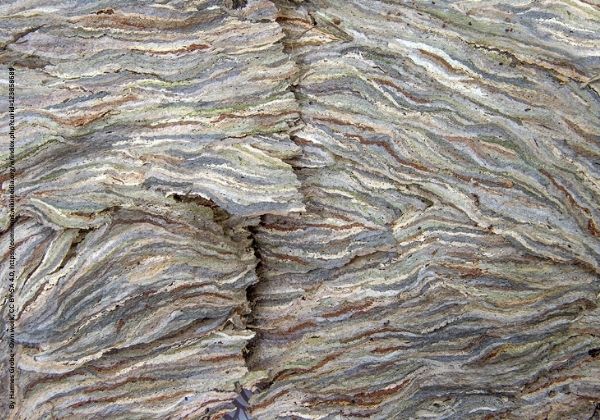
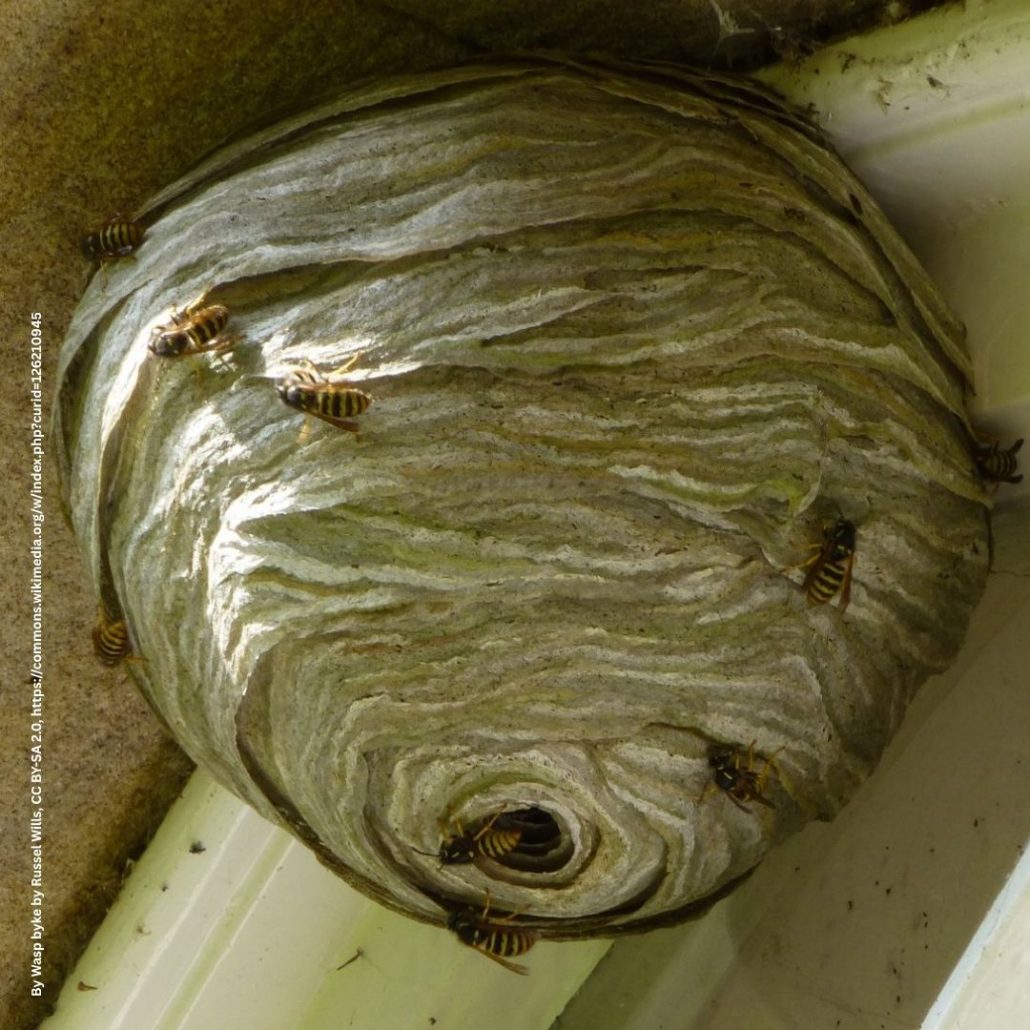
Wasps make their nests by chewing up tiny pieces of weathered wood and mixing them with saliva to create a paper-like material.
Layer by layer, they build beautiful swirling patterns in shades of grey, cream and brown.
Eilish said watching the wasps at work was fascinating, describing the nest as looking like “exotic paper”.
Why aren’t the wasps attacking?
Many people are frightened of wasps, but they’re usually much less aggressive than people think.
Wasps only sting when they feel threatened or when they’re defending their nest.
If you stay calm and give them space, they’ll usually ignore you completely.
Eilish joked that she simply walked calmly through the office “like a browsing cow” so the wasps wouldn’t think she was a danger!
What’s the point of wasps?
Wasps often get a bad reputation, but they’re incredibly important.
They help control insects that can damage crops and gardens by catching flies, caterpillars and other bugs to feed their young.
Many wasps also visit flowers to drink nectar, helping to pollinate plants as they move from flower to flower.
Without wasps, many ecosystems would struggle to stay healthy.
The Norfolk Wildlife Trust has a brilliant guide explaining why these fascinating insects deserve a little more appreciation.
👉 Read more: What’s the point of wasps?
What will happens to the nest?
By autumn, the worker wasps will have completed their life cycle and the colony will naturally die out.
Only a few newly mated female wasps, called queens, will survive the winter by hibernating.
Next spring, each queen will wake up and build a brand-new nest somewhere else.
That means the giant office nest will never be used again — but it will remain as an amazing example of nature’s engineering.
Learn more about Norfolk Wildlife Trust
The Norfolk Wildlife Trust protects wildlife and wild places across Norfolk while helping people discover and enjoy nature.
If you’d like to explore more incredible wildlife stories, visit the Norfolk Wildlife Trust website and discover why every creature — even wasps — has an important role to play.
Curious about nature?
Whizz Pop Bang is the award-winning magazine for curious children aged 6–12. Every month it’s packed with amazing science news, experiments, wildlife, engineering, space, puzzles and hands-on activities to inspire the next generation of scientists.
Subscribe today and bring a new science adventure through your letterbox every month!