Whizz Pop Bang readers often ask us curious questions (we print some of the answers in every magazine!). Last week we were lucky enough to talk to incredible physicist Jim Al-Khalili and ask him directly!
We asked Whizz Pop Bang fans to let us know what they’ve been wondering about and they came up with some fascinating questions for Professor Jim.
What would happen if you fell into a black hole? Could you travel backwards in time? And did time even exist before the Big Bang? Read on to find the answers to these mind-boggling questions.

What would happen if you jumped into a black hole?
Asked by Bella and Tilly
Jim says:
“That wouldn’t be good! Bella and Tilly, if someone says, ‘Let’s go and jump in a black hole,’ you should be very careful to think about it first. There are different kinds of black holes. Sometimes a star can collapse into a black hole – those are quite small black holes. If you fell into one of those, you would get stretched. This wonderful concept has a very scientific name: spaghettification.
You get pulled out like spaghetti because if you jump in feet first, your feet get pulled in more than your head and you get stretched, which would not be nice.
If you wanted to avoid spaghettification, you could jump into what’s called a supermassive black hole, and that would be much gentler. You could enjoy the ride down, but you might still end up hitting what’s called the singularity which is where you get squashed down to zero size, and that’s even worse than being spaghettified.
No one’s ever jumped into a black hole, and we haven’t ever sent any probes into one. They wouldn’t come out if we did! But the math says that is black holes are spinning very fast, then in the middle there could be a kind of ring called a star gate which you could travel through. You could end up in another part of the universe altogether, or even in a parallel universe.
So the math tells us all sorts of weird and wonderful things but until we can test it with an experiment we can’t be sure if it’s right. We have a lot of fun speculating about it!”
Why can’t we travel back in time?
Asked by A, aged 9
Jim says:
That’s a fascinating question. Actually, the laws of physics that we have understood going all the way back to Albert Einstein tell us that time travel into the past is in principle possible.
It hasn’t been ruled out by equations. Physicists go by equations that we’ve tested and found to be correct. We think Einstein’s equations are correct because we’ve tested them on other things, more mundane than time travel, and it turns out that they’re correct. These equations also say that we could travel back in time.
It’s certainly easier to go into the future because you can do that by slowing time down. If you travel close to the speed of light or orbit around a black hole a few times, gravity can slow time down.
Going back into the past is a bit like looping the loop on a rollercoaster. You’re travelling forward in time, but what Einstein says is that gravity causes time and space to bend and so, even though you’re travelling forward, you’re actually doubling back on yourself and you end up in the past, the way you started before you started.
Now, the problem is that most scientists would argue that it’s probably still impossible. There may be some loopholes that we need to close because it leads to all these logical paradoxes. If you go to the past you can only change things and make them turn out the way they have already turned out – like everything from Doctor Who to famous movies like Back to the Future.
It’s all very strange and you can very quickly get yourself into a tangle – how can that be? Surely, if they went back, they ought to change this. So logic says it’s not possible, but physics says it may be. It’s mind-bending and space-bending!
Professor Jim Al-Khalili is a physicist, broadcaster and the presenter of this year’s Royal Institution Christmas Lectures which will be shown on the BBC and iPlayer this December. He is all about inspiring curious minds to question the world around them (which is something we’re passionate about at Whizz Pop Bang, too!)
Did time exist before the big bang?
Asked by Olivia
Jim says:
If we follow Einstein’s theory of relativity (which told us about the Big Bang) then that would say that time started at the Big Bang. And if you say, ‘What was there before?’ – well there was no before: that’s when time started. If people find that puzzling, how about I explain it like this: If I say to you, walk to the South Pole then when you get to the South Pole, keep heading south. You’re already as far south as you can go on the surface of the Earth. Any step from the South Pole takes you back north again. The Big Bang is a bit like that with time. It’s the earliest moment of time, all times from the Big Bang head into the future, so there’s nothing in the past.
Most physicists will just tell you that and say ‘That’s it, time began with the Big Bang, now go away and don’t ask me anymore hard questions!’
But there are now physicists or cosmologists (scientists studying the entire universe) who are starting to think that maybe there was time before the Big Bang. Maybe the Big Bang was just the beginning of our universe, and maybe there were other universes popping in out of existence in some higher dimensional multiverse.
Maybe time has always existed.
We think time started with our universe, but maybe there’s time even before our universe was born. That’s a possibility, but we don’t know if it’s correct or not because we’re not quite sure how to test that idea.
Maybe there have been lots of Big Bangs. Maybe the universe will expand, recollapse into what’s called the big crunch, which will then become the Big Bang of the next generation universe. Ours may not be the first cycle.
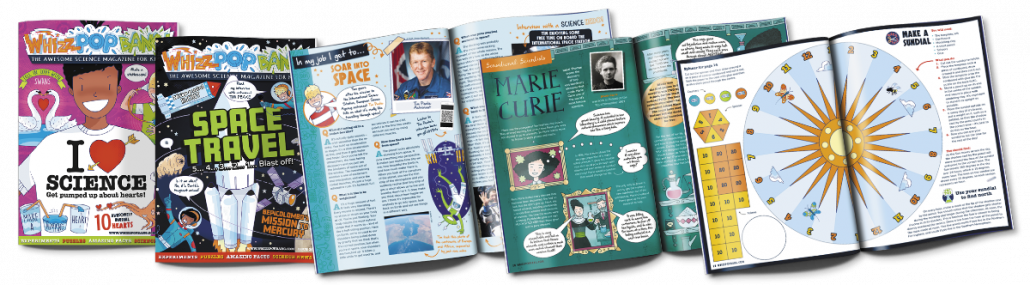
Whizz Pop Bang magazine is filled with intriguing-yet-simple explanations of fascinating science topics. Send your child’s questions to [email protected] – our robot, Y, answers readers’ questions in every edition!
Whizz Pop Bang is our award-winning science magazine that brings science to life for girls and boys aged six to twelve (and their parents too)! Check out our subscriptions here.