Sharpshooter insects catapult droplets of wee at high speeds. Researchers have found they do this using an anal stylus, which they nicknamed the ‘butt flicker’, which is a bit like the flippers on a pinball machine. You can watch them in action here:
British Science Week is an exciting annual celebration of science, technology, engineering, and mathematics (STEM) in the UK. This year, it’s being celebrated between 10th – 19th March (2023) and there will be a wide range of activities, events, and opportunities for children and adults to explore and engage with science held all over the UK.
There will be lots of different events and activities to get involved in. Why not do some kitchen science at home, go to a science exhibition or science fair, listen to a science talk or get involved in a citizen science project? The aim of British Science Week is to inspire curiosity, interest and excitement in STEM and to help people learn about the latest scientific discoveries and advancements.
Whether your child is already interested in science or is just curious and keen to learn more, British Science Week is a wonderful way for them to explore science and discover the many exciting things that science has to offer.
Here are some tips to get stuck into science this British Science Week:
Do some kitchen science experiments!
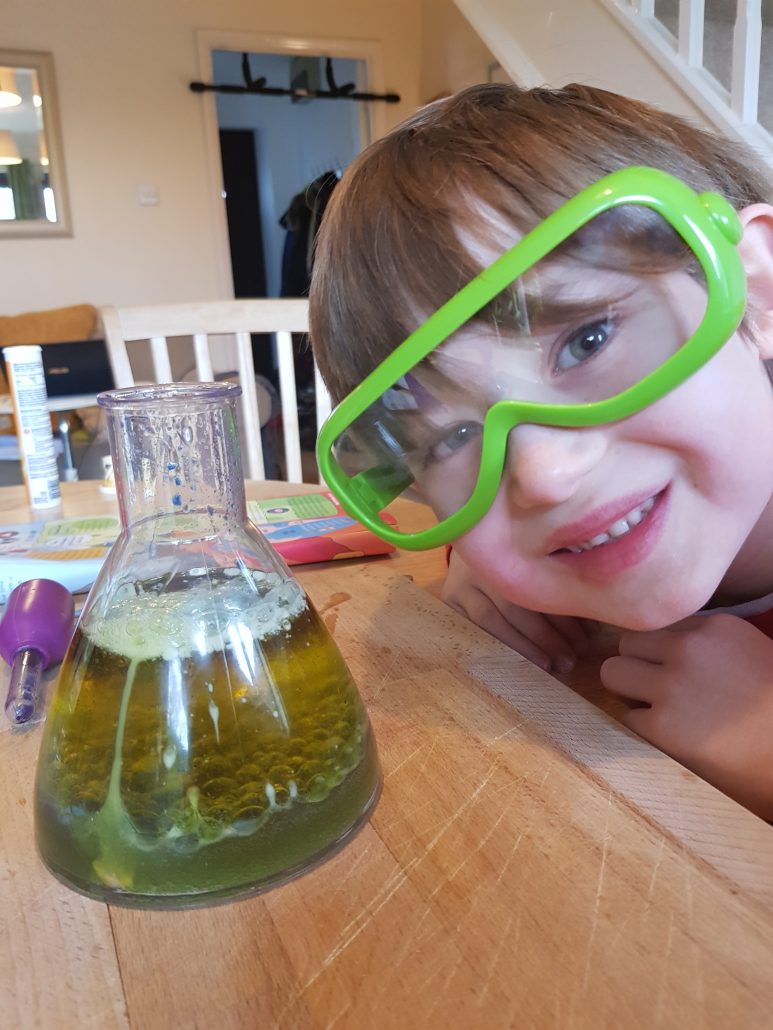
Home science experiments are a great way to introduce your children to the world of science. You don’t need a fancy lab to do this. Simple household items like vinegar, baking soda, food coloring, and balloons can be used to create some exciting experiments. If you’re already a Whizz Pop Bang subscriber, you’ll know just how much science fun is to be had with simple household items! Here are some free science experiments you can do at home, or why not stock up on some Whizz Pop Bang issues from the shop?
Science museums and exhibitions often have interactive exhibits that are sure to keep your children engaged, entertained and inspired about science. They will be able to see science in action and learn new things.
Science events and talks can be incredibly engaging and informative. There are so many exciting talks and events taking place during British Science Week, so why not take advantage of them? These events are an excellent way to explore science, meet scientists, and learn more about the fascinating world of science.
In the UK, you can visit: sciencelive.net to find an event near you!
Depending on where you are in the world there will most likely be a science museum, exhibition or talk you can visit.
Download the official activity pack!
The free activity packs for British Science Week 2023 are available to download now! There are different options for Early Years pack, Primary pack, Secondary pack and Community pack.
Each pack, created with the support of UK Research and Innovation and 3M, includes a wide range of fun, hands-on activities, and loads of useful information for planning your events for the Week.
Citizen science projects allow members of the public to contribute to scientific research. There are many projects that are suitable for children, such as counting birds in your garden or identifying plants and animals in your local area. You can find many citizen science projects online that you can participate in as a family.
British Science Week is having a poster designing competition all about this year’s topic – connections! Why not encourage your mini-scientist to get involved? Entries close on the 31st March and they could be in for a chance of winning one of their awesome prizes, from posters, play sets, tickets to events and books. This competition is open for children aged between 3 – 14 years old, to find out more click here.
Celebrating British Science Week is a great way to spark their curiosity and love for science. From home science experiments to immersive events, there are many ways to explore science together. We hope these tips have given you some inspiration for your science adventures during British Science Week 2023. Have fun exploring science with your children!
Fill your child with science wonder with a subscription to Whizz Pop Bang, the award-winning magazine for 6 to 12-year-olds. Watch their face light up with glee when their very own magazine zooms through the letterbox! Packed full of hands-on science awesomeness, it’s the gift that keeps of delighting, month after month.
With Easter just around the corner, we’ve put on our thinking bonnets and come up with the best Easter science experiments, bouncing bunny crafts and fun egg activities to share with you. These simple, exciting science experiments are a brilliant way to keep young brains whirring all year round!
1. Take Whizz Pop Bang’s Awesomely Amazing Science Quiz!
Round up the family, find some pens and paper and pop open a packet of chocolate eggs – it’s time to get quizz-ical with this Easter quiz! Suitable for children and adults alike, this quiz will get you wondering about the world’s largest eggs, rabbit anatomy, the science of chocolate and so much more.
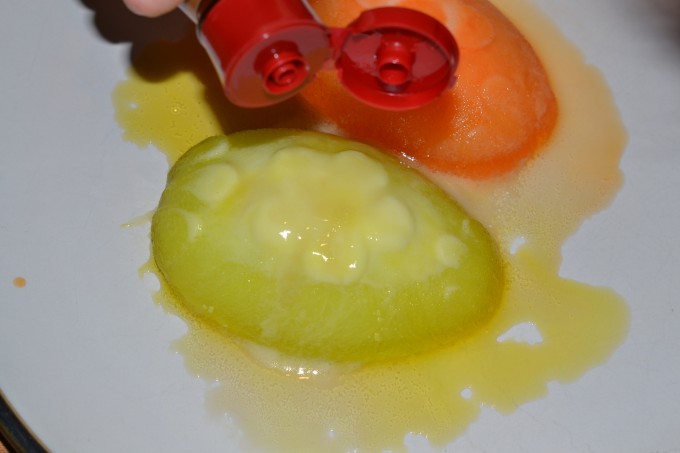
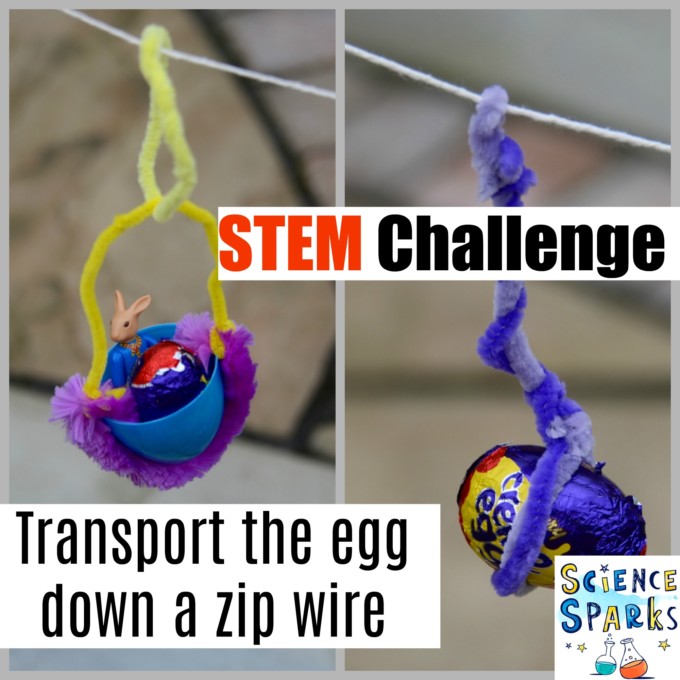
This kitchen chemistry activity uses bicarbonate of soda (called baking soda on this site) and vinegar to create a fizzing reaction that is guaranteed to excite young scientists. Pop a small toy into an egg mould, fill with coloured water and a little bicarbonate of soda then put it in the freezer. Once frozen, use warm water and vinegar to set the toy free! Head this way for the full instructions.
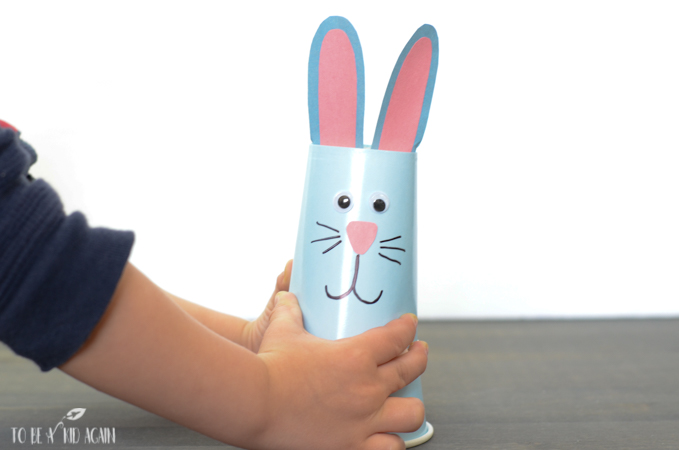
Turn two paper ups, an elastic band and some craft supplies into an Easter bunny that really bounces. Explore elasticity and forces with this fun Easter science activity! Find out everything you need to know here.
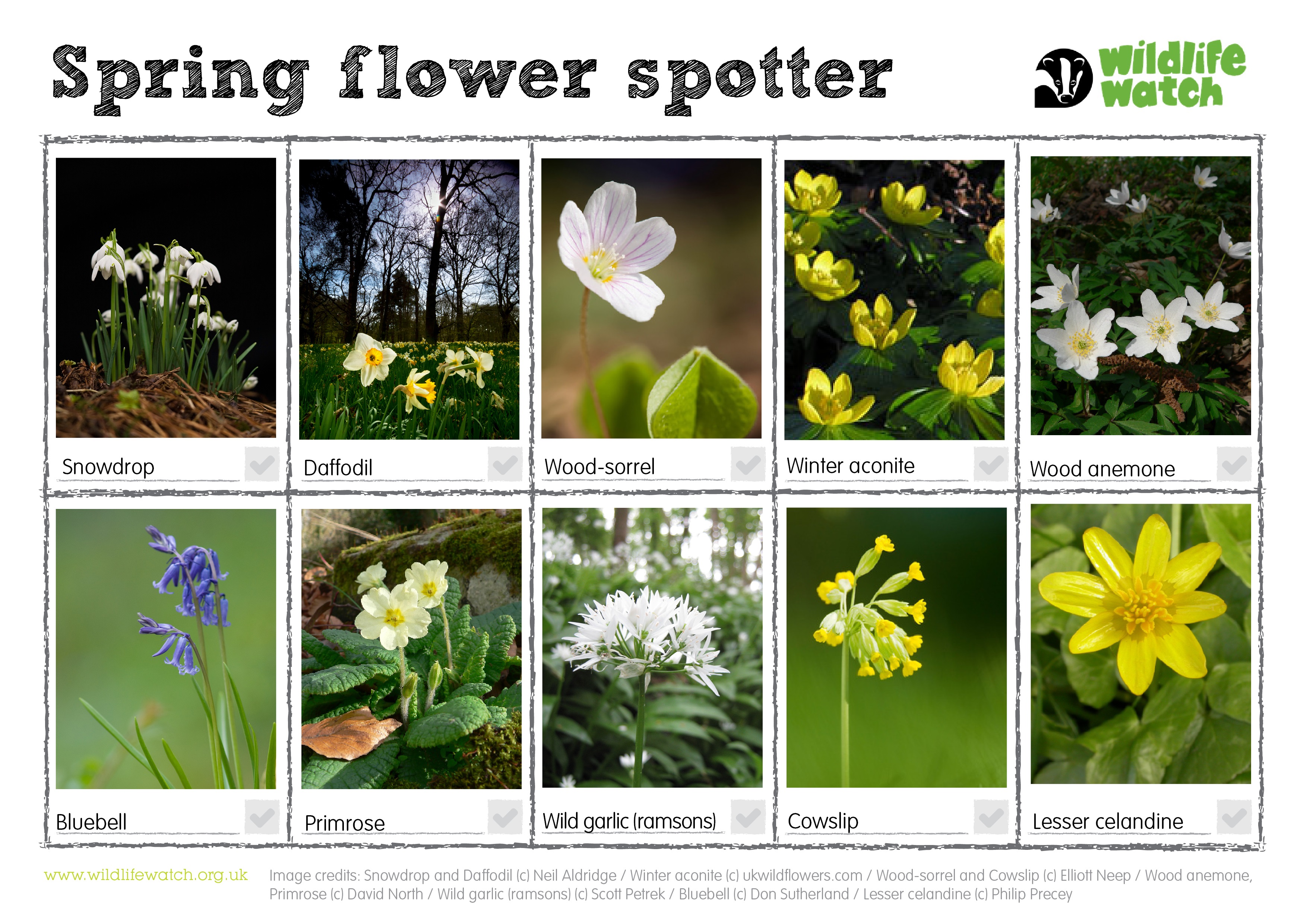
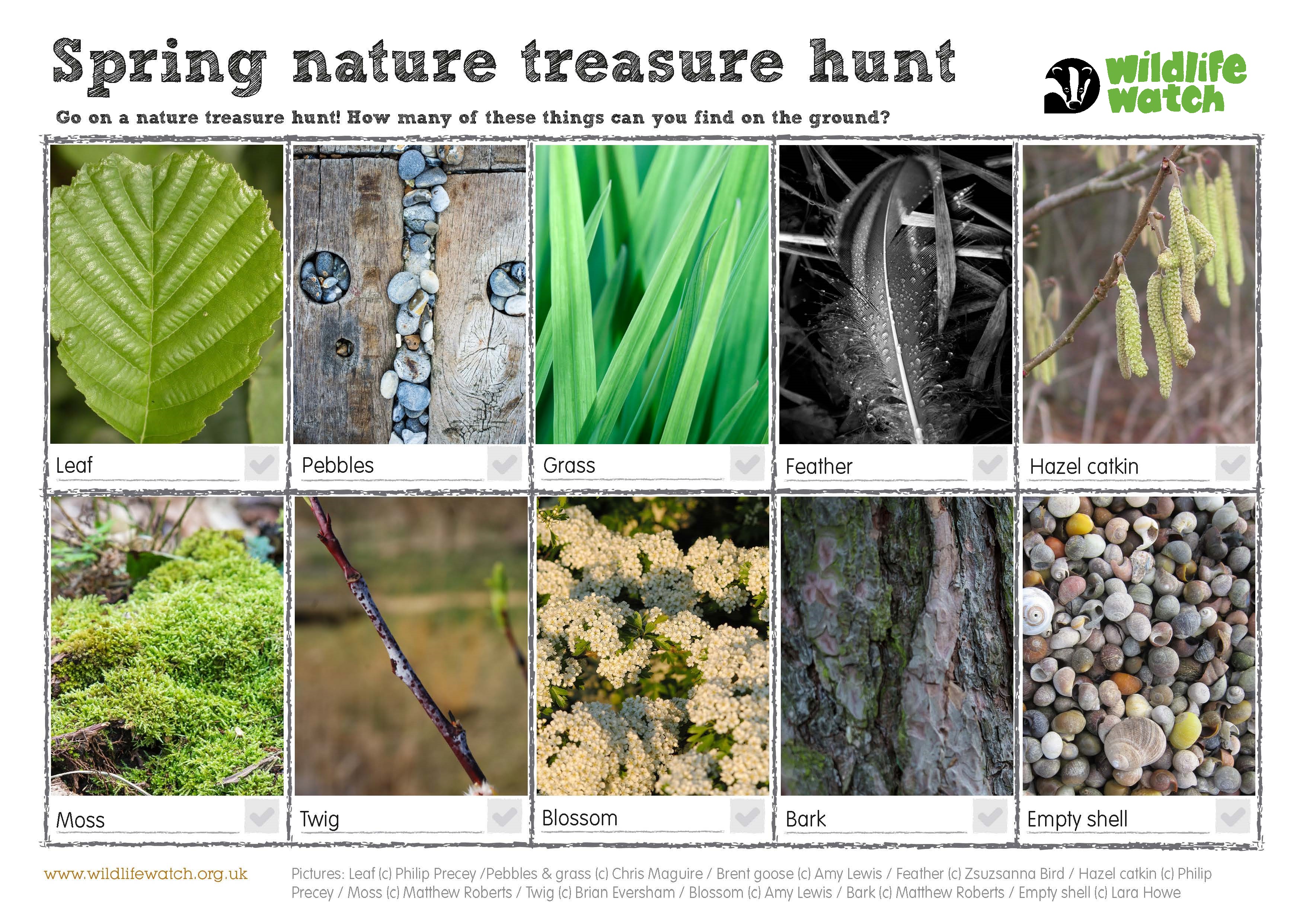
Do you know your celandine from your aconite? This printable treasure hunt is the perfect Easter holiday activity for all ages. Find this nature quiz here.
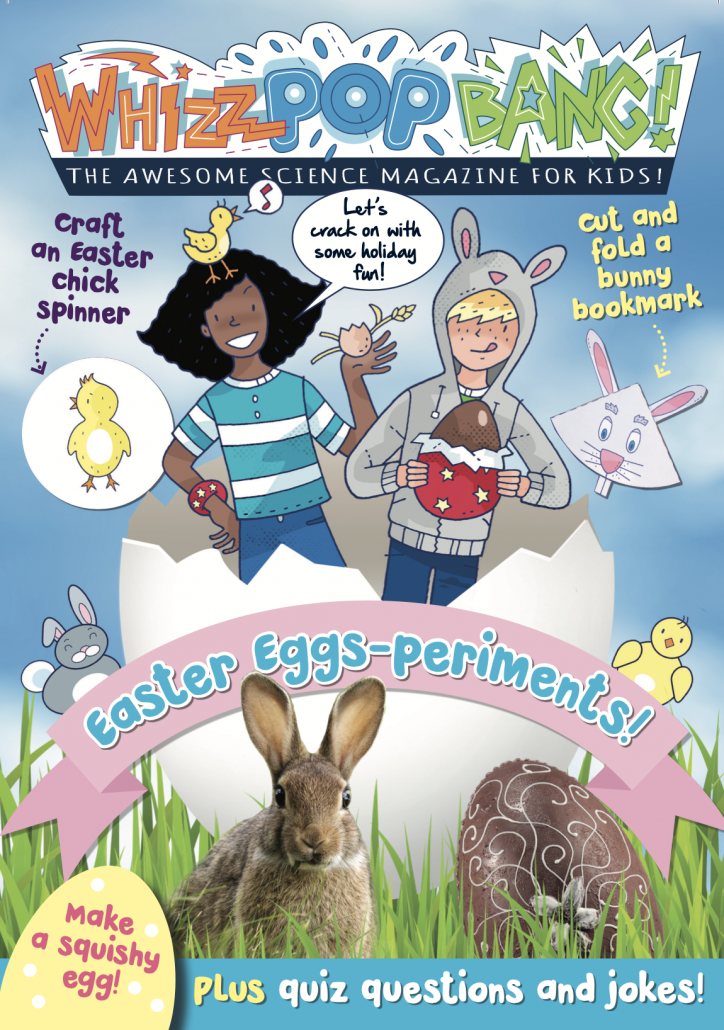
5. Pick up Whizz Pop Bang’s Easter science booklet – for FREE!
Whizz Pop Bang’s Easter Eggs-periments booklet is packed with brilliant science activities, including… 🐣 Make dragon eggs 🐣 Grow egg geodes 🐣 Make a bunny bookmark 🐣 Puzzles 🐣 Crafts 🐣 Quiz questions 🐣 Jokes And more! Best of all? It’s FREE!*
* Offer valid until midnight on 01.04.23 on Whizz Pop Bang products purchased using the coupon code EASTER23. Not valid in conjunction with any other offer. Orders will be dispatched by Royal Mail within two working days. We recommend ordering by 28.03.23 for delivery in time for Easter but cannot be responsible for any delays to delivery.
We can’t get enough of fizzy eggs at Easter! This blog post includes a brilliant foaming variation using washing up liquid. Find out how to give it a try here.
Warmer days are on the way so it’s the ideal time to plant some seeds, start growing some food and see some amazing science in action!
10. Make a bendy carrot
Make like a rabbit and experiment with carrots! Investigate osmosis from your kitchen table using two simple ingredients: carrots and salt.
Want to explain osmosis to kids? Here goes… Water moves from an area of low salt to an area of high salt – balancing the water on both sides.
In this experiment, when a carrot is placed in very salty water, it will be less salty than the area around it. This causes the water in the carrot to move out of the carrot and into the cup. The result is that the carrot becomes limp and tastes saltier than before.
PS We agree with the end of this video – don’t eat the salty carrots!
Do you want to plan a whole-school science day? We have a mystery for the whole school to solve! The children will practise their observational skills and learn about the job of a forensic scientist.
Before the pupils come in, set up a crime scene. The crime is that someone has eaten the last cookie from the staffroom. You will need to decide which member of staff is the culprit and plant the evidence accordingly. There will be lots of clues; a handwritten note, some footprints, a glass with clear fingerprints on. The crime scene will need to be in an area that the whole school can visit and access during the day. You could set it up in the hall and have a whole-school assembly to explain the crime. The evidence could then be put on a crime scene board and each year group given one piece of the evidence to investigate, just like forensic scientists.
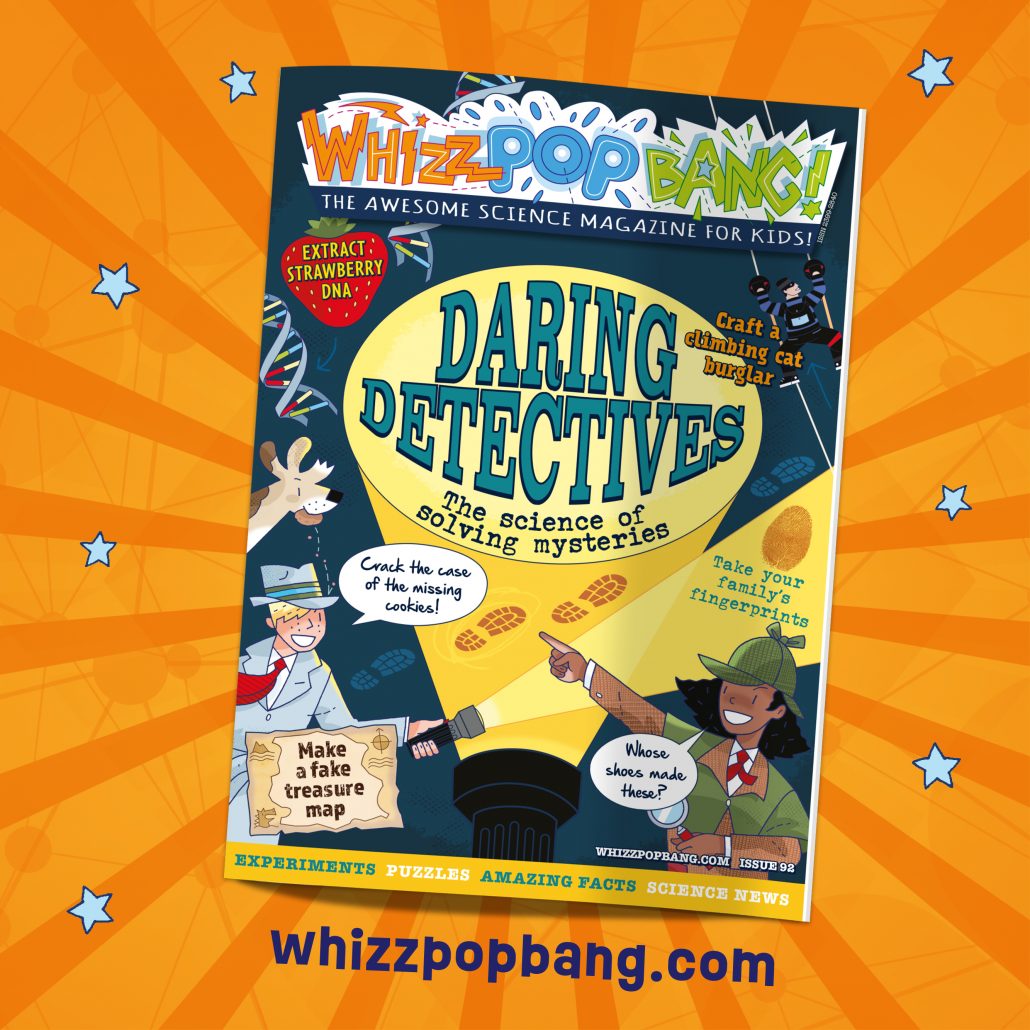
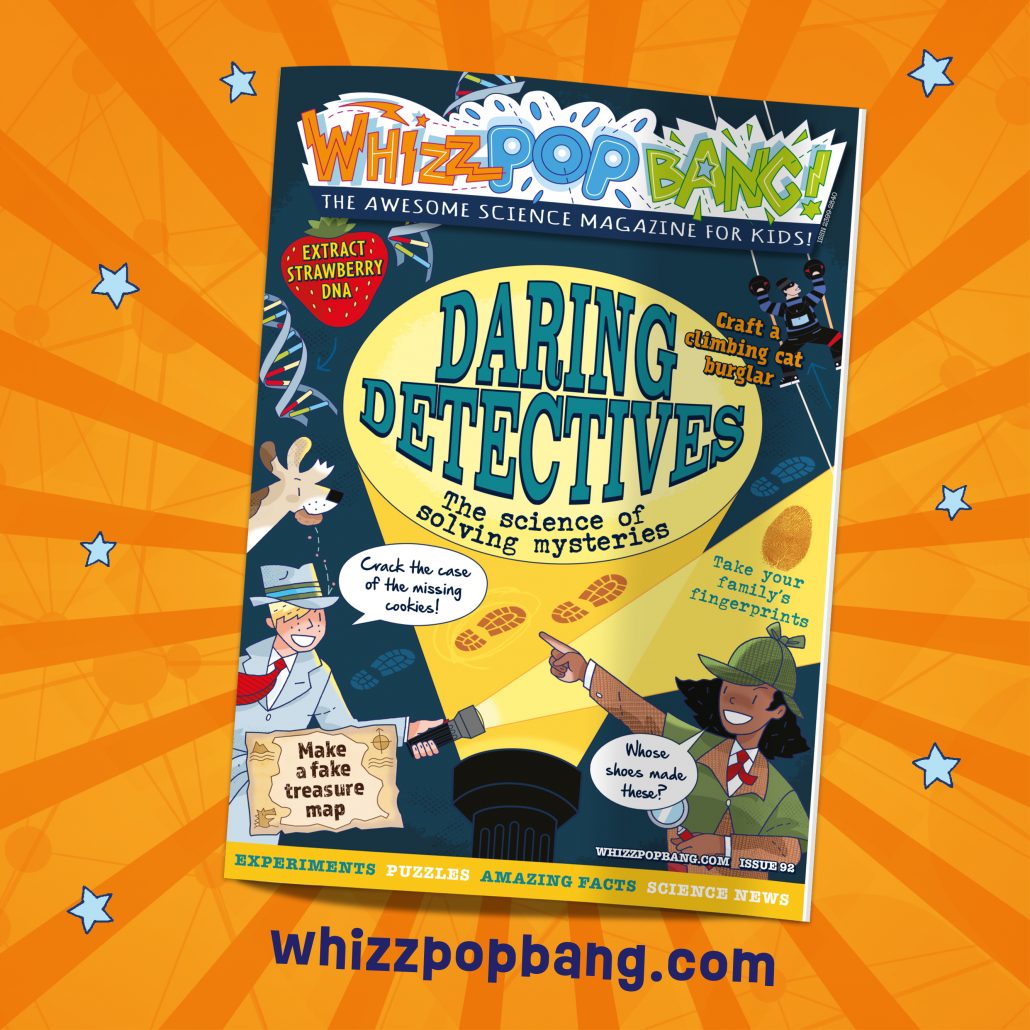
Check out our detective science issue!
F2
Part of crime detection is looking carefully for clues. Pupils could play lots of games in which they must spot the odd one out; for example, fill two trays with objects so they look identical, but with something missing from one tray – can they spot it?!
Year 1
They will investigate footprints. Pupils will first compare their shoeprints to find out if they are the same. They could then ask all the members of staff for their shoeprints. Can they match any of them to the ones at the crime scene?
Years 2 and 3
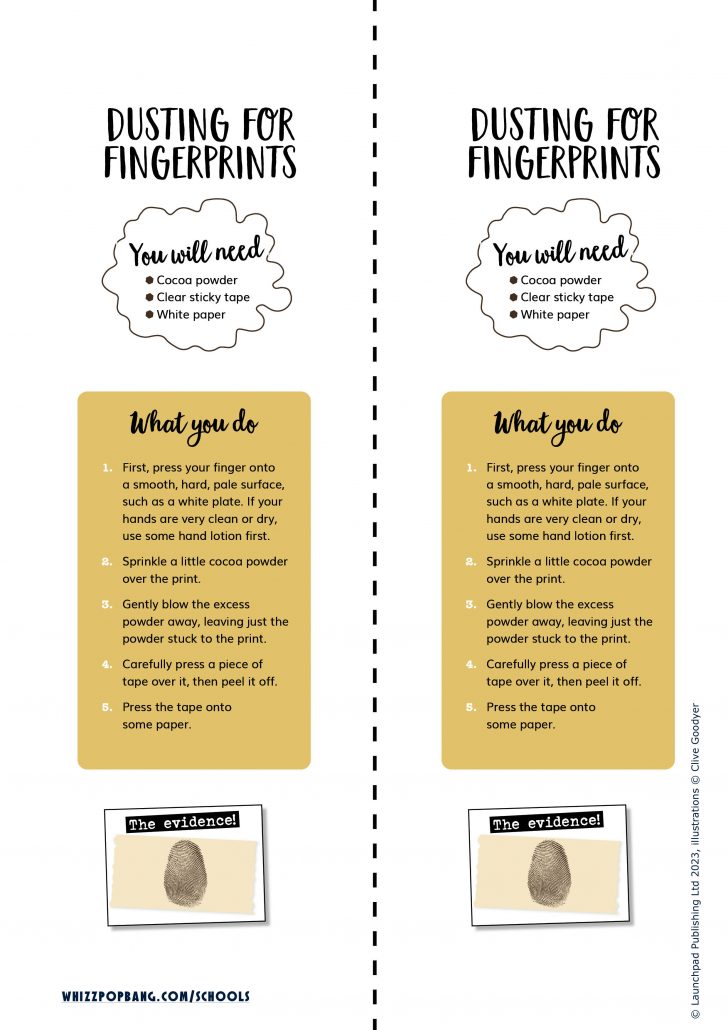
They will be taking fingerprints. Are all of our fingerprints the same? Discuss how they are unique. Follow these instructions to take fingerprints.
Year 3 pupils could take the fingerprints of all the staff members and see if they can match any of them to the ones at the crime scene.
Years 4 and 5
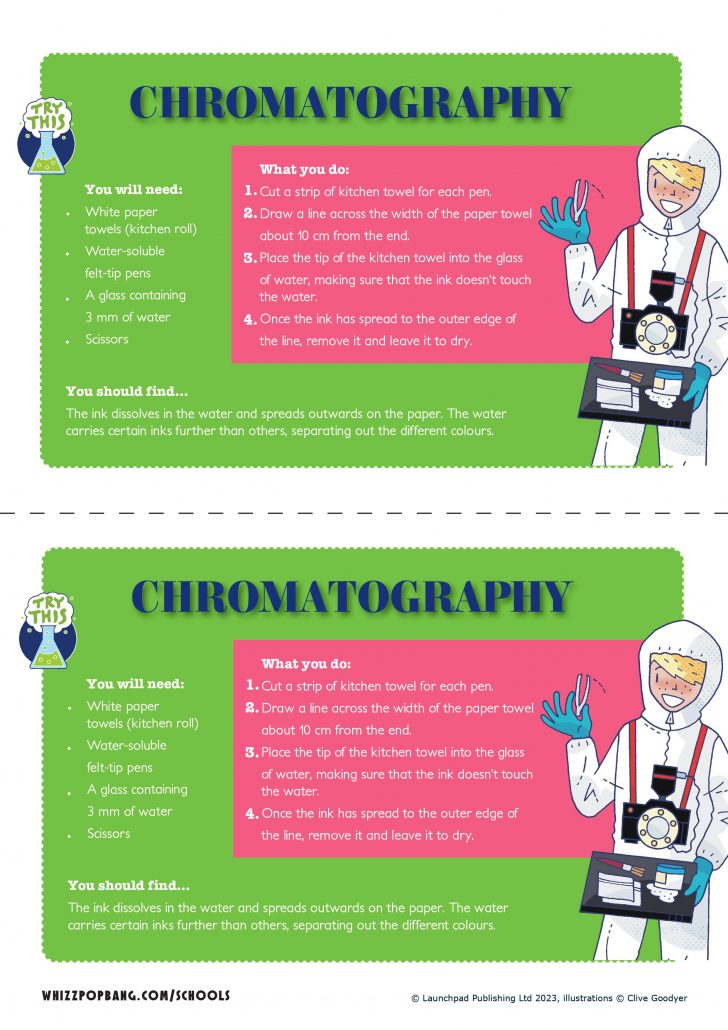
Can they match a pen to the note from the crime scene? Give pupils a selection of pens, each one belonging to a different member of staff. (You will need to use water-soluble pens for the test to work.) In the crime scene, make sure there are some pieces of kitchen roll with ink spots on them, which match the note left by the cookie-stealing culprit.
Pupils will try out chromatography. You will demonstrate how to do it and then they will test the staff members’ pens, making sure they work methodically to ensure it is a fair test. Do any of the pens match the clue in the crime scene?
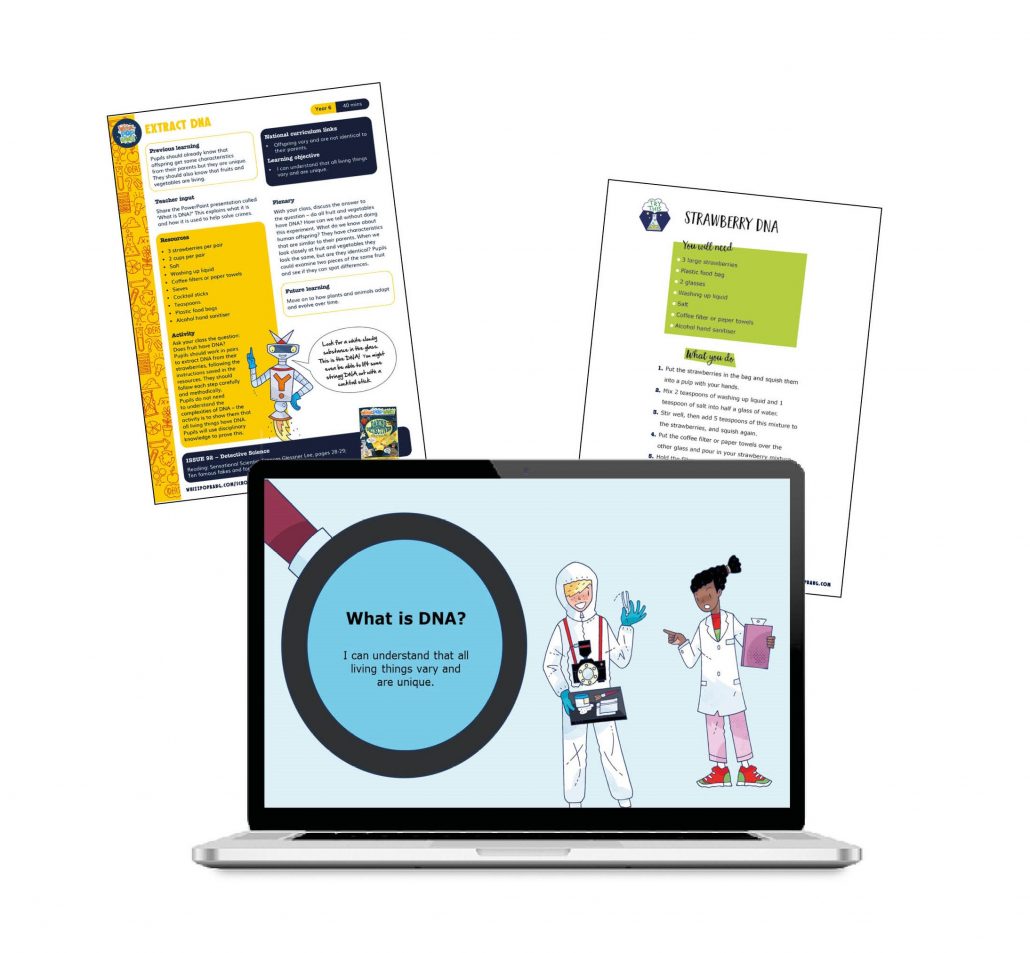
They should already know that humans are all different and that we carry characteristics from our parents. Explain that we all have DNA – in fact, all living things have DNA – and that it can be used to help to solve crimes. Scientists can extract DNA from all sorts of evidence, including hairs, fibres, etc. Explain that it would require specialist equipment to do this, but we can extract a DNA strand from a strawberry.
Download our lesson pack here for the full instructions:
At the end of the day, bring the whole school back together. Ask each class if they think they know who took the last cookie. Work through the crime scene board and see if they all came up with the same member of staff. Did they manage to solve the crime?
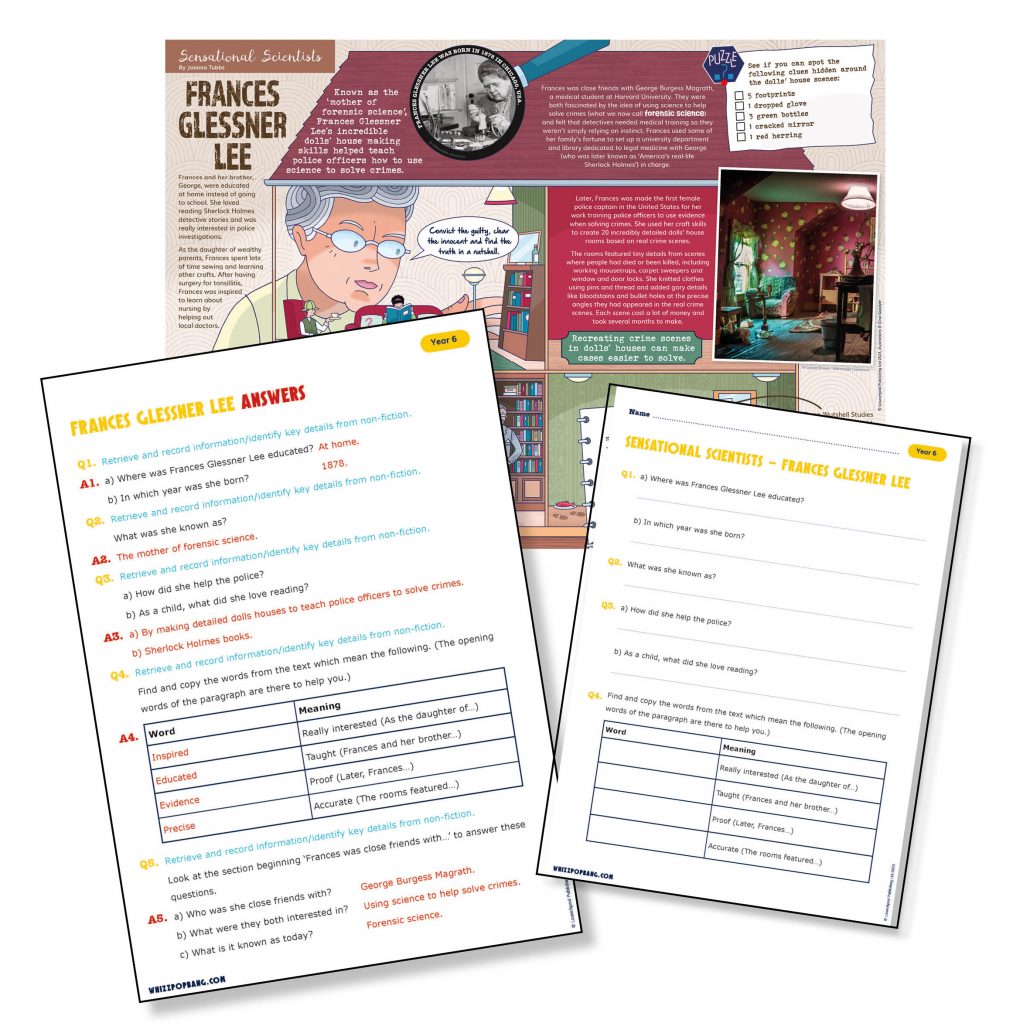
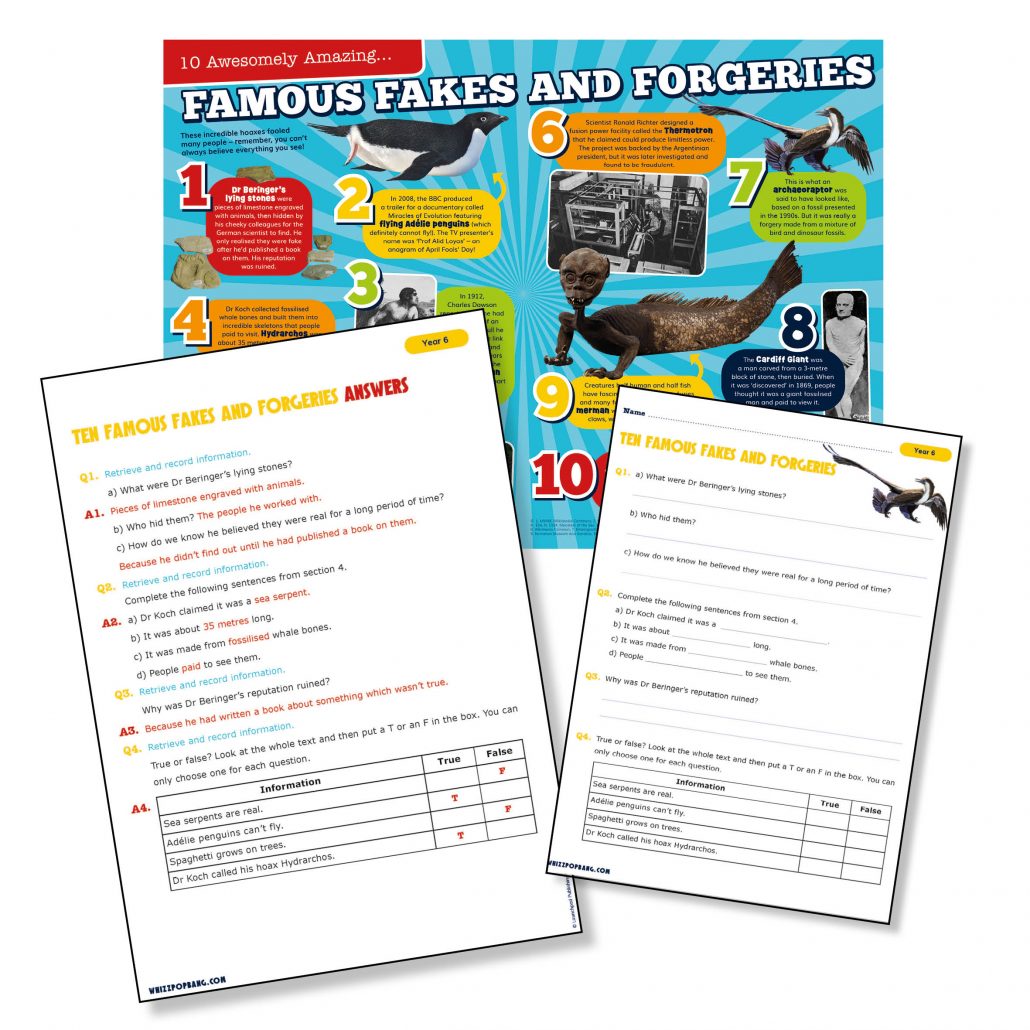
As part of the day, pupils might like to read about some real-life detectives or some animal thieves. Check out these reading comprehensions available to download from our website:
Whizz Pop Bang magazine and teaching resources are brilliant ways to enhance your school’s science teaching:
We provide downloadable science lesson plans, PowerPoint presentations, hands-on investigations and science reading comprehensions written by primary school teachers.
Whizz Pop Bang teaching resources link to the National Curriculum, ensuring correct coverage.
All of our resources are year group specific, ensuring progression between the years.
We make cross-curricular links to other subjects, such as English, Maths, History, Geography, Art, Design and Technology and PSHE.
Prices from as little as £197.99 per year for a copy of Whizz Pop Bang magazine through the post each month and whole-school access to our ever-growing library of downloadable teaching resources, with unlimited teacher logins.
We’ve also launched a new individual membership option so teachers and home educators can access all of our amazing downloadable resources for just £20 for the whole year.
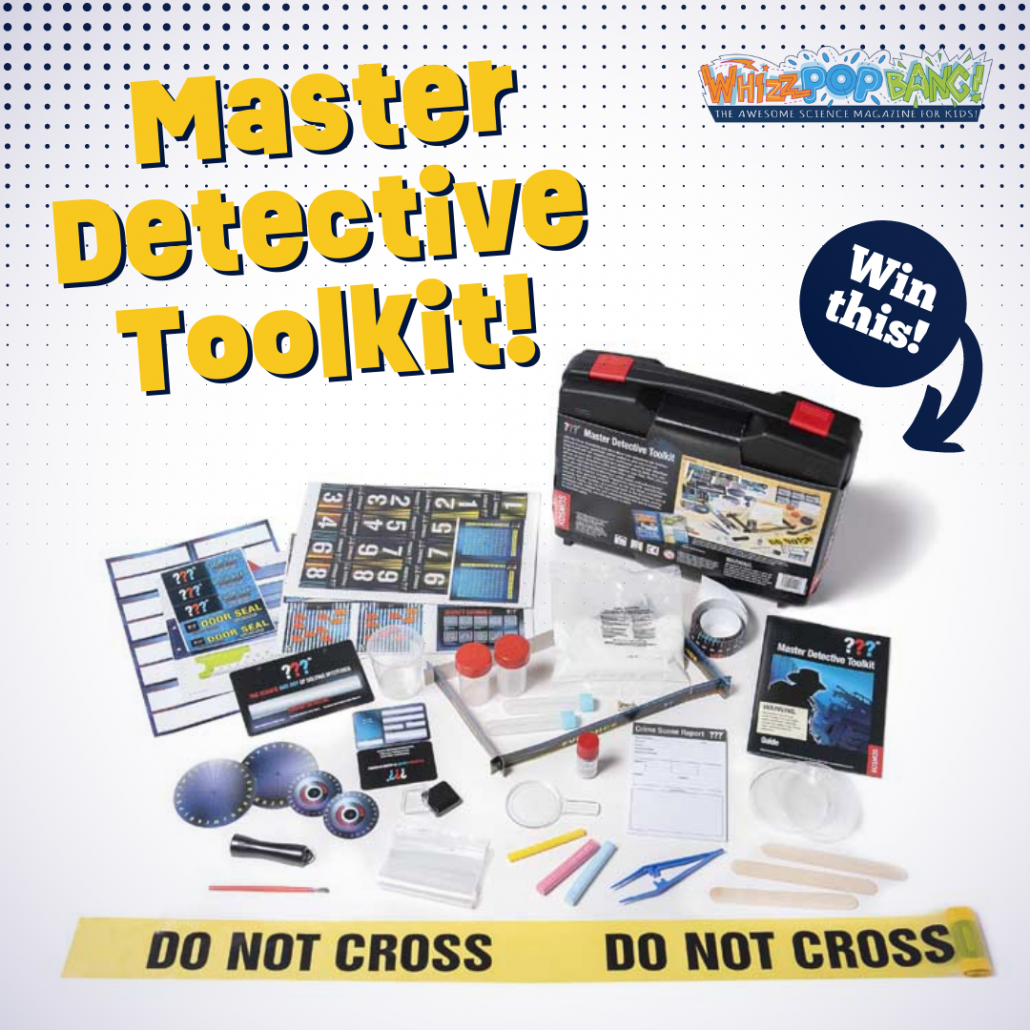
Enter to be in for a chance of winning one of four awesome Master Detective Toolkits from Thames and Kosmos!
Learn about how real detectives use forensic science to answer questions, gather evidence, and solve crimes. You’ll begin by setting up your detective’s office, then hone your observation skills with exercises. Move on to secure a crime scene and gather and document evidence such as fingerprints, footprints, and tyre tracks. Afterwards, head to the lab to analyse the evidence and learn about deciphering codes, writing with invisible ink, and communicating with secret symbols. Finally, you can apply all your skills and knowledge to solve a mock crime presented in the accompanying manual.
This 32-page book is full of illustrations and step-by-step instructions to guide you through your investigation. Start your adventure today and become a master detective!
For your chance to win, simply answer this question in the comments:
Colin Butcher and his detective dog use their skills (and some science) to solve animal crimes. He’s told us some incredible stories in Whizz Pop Bang: DARING DETECTIVES, but we wanted to share even more with you!
Colin has written a book about his clever cocker spaniel, Molly.
With the help of Molly, the Pet Detective Dog, and the team at The Pet Detectives, Colin has great success in recovering missing or stolen cats, dogs and other animals throughout the UK.
We once had a client who lived in the USA, who had donated $50,000 to help save unwanted dogs from the streets of Turkey. The story was, a lady who was running a rescue centre in Turkey would ship these dogs to America where they would be given new homes. Unfortunately, the woman who was running the rescue centre started to spend the money on herself and neglected the dogs. One of the dogs, Lucy, was going to be adopted by our client – but she disappeared from the rescue centre just before the police arrived.
We were asked to conduct an investigation and find Lucy. We discovered that the day before the police had arrived at the rescue centre in Turkey, a delivery van had collected one of the dogs and left for eastern Europe. We found out that the van belonged to a company in Romania who occasionally delivered goods to England. We suspected that Lucy may have been smuggled out of Turkey, taken to Romania, and was now heading for England under a false name. We managed to find all the locations the van had delivered to in England, one of which was very close to a small dog rescue in Cumbria. We researched the rescue centre and discovered that the owner was a friend of the woman who lived in Turkey.
A week later, we went to the rescue centre in Cumbria and pretended to be looking for a new pet. We discovered Lucy (also known as Lady) tucked away in a small compound at the back of the rescue centre. We managed to convince the owner of the centre to let us adopt Lady and a few days later she was on her way to America to start a new life with our client.
Van-ished cat
Lulu, a Silver British Short-Hair climbed into the back of a delivery van in Wimbledon and jumped out when the driver arrived back at his depot. We worked out where Lulu had gone and introduced camera traps and feed stations to encourage her to remain in one spot. We then introduced a den for her and after five days we recovered her from the exact same spot where she had last been seen. She had sustained quite a bad injury whilst missing but, after receiving the appropriate care, made a full recovery.
Return to owner
Derrick abandoned his home in Willesden after being forced out of his territory by an older, more dominant tom cat. Working closely with Derrick’s owner, we removed the threat from the more dominant cat and then introduced a displacement strategy to encourage Derrick to return home. He was recovered one day later and is now safely back with his owner.
To celebrate Introduce a Girl to Engineering Day on the 25th February 2023, here are some fun and inspiring activities and interviews to share with the girls in your life. You never know, one might grow up to be an engineer!
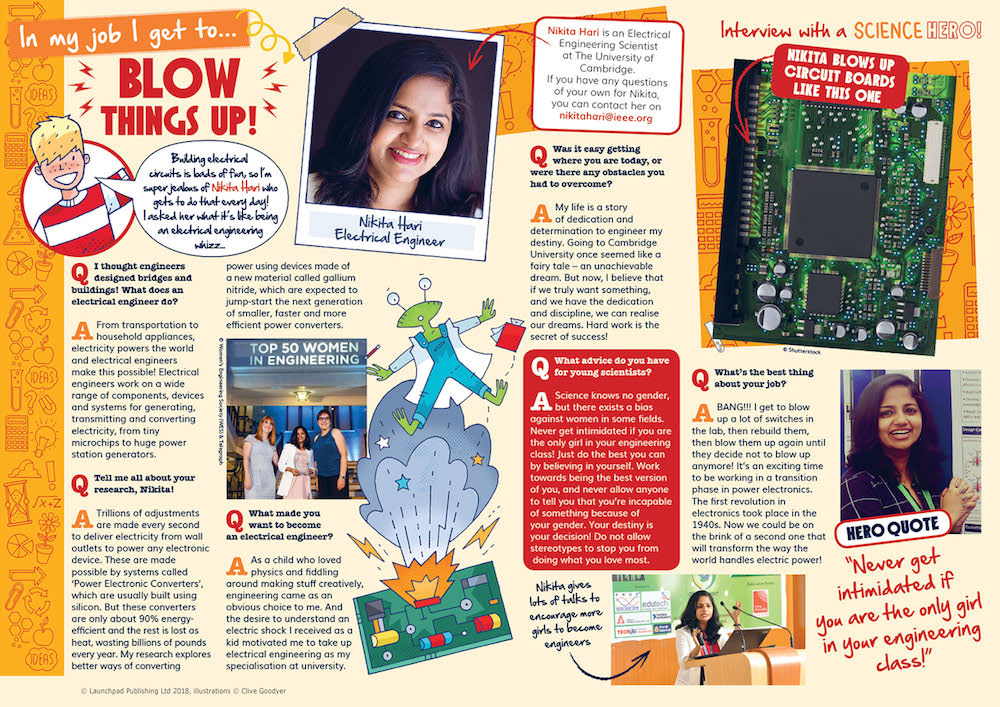
Reading comprehension: Electrical Engineer
Find out what it’s like to be an electrical engineering whizz with this inspirational interview with Nikita Hari. Includes the feature to print or to read on a tablet, as well as comprehension question and answer sheet.
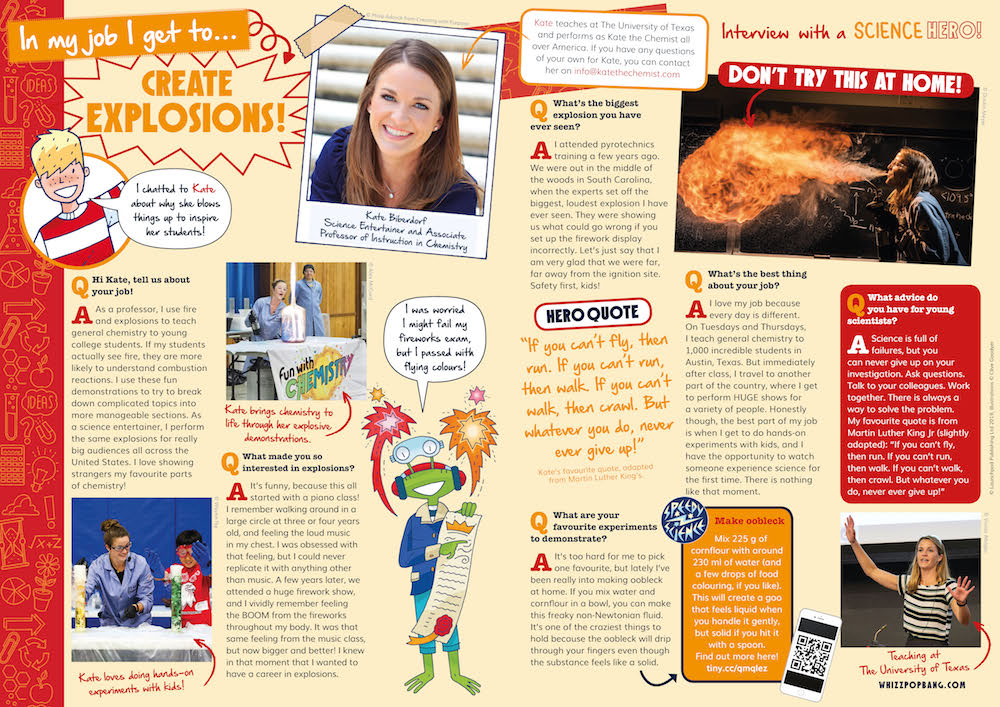
Find out why Kate Biberdorf loves to blow things up to inspire her students! Includes the feature to print or to read on a tablet, as well as comprehension question and answer sheets.
Epic Engineer Badge Think like an engineer to earn an Epic Engineer badge! Identify a problem, design a solution, get building, then test and improve your design.
Fill your child with science wonder with a subscription to Whizz Pop Bang, the award-winning magazine for 6 to 12-year-olds. Watch their face light up with glee when their very own magazine zooms through the letterbox! Packed full of hands-on science awesomeness, it’s the gift that keeps of delighting, month after month.
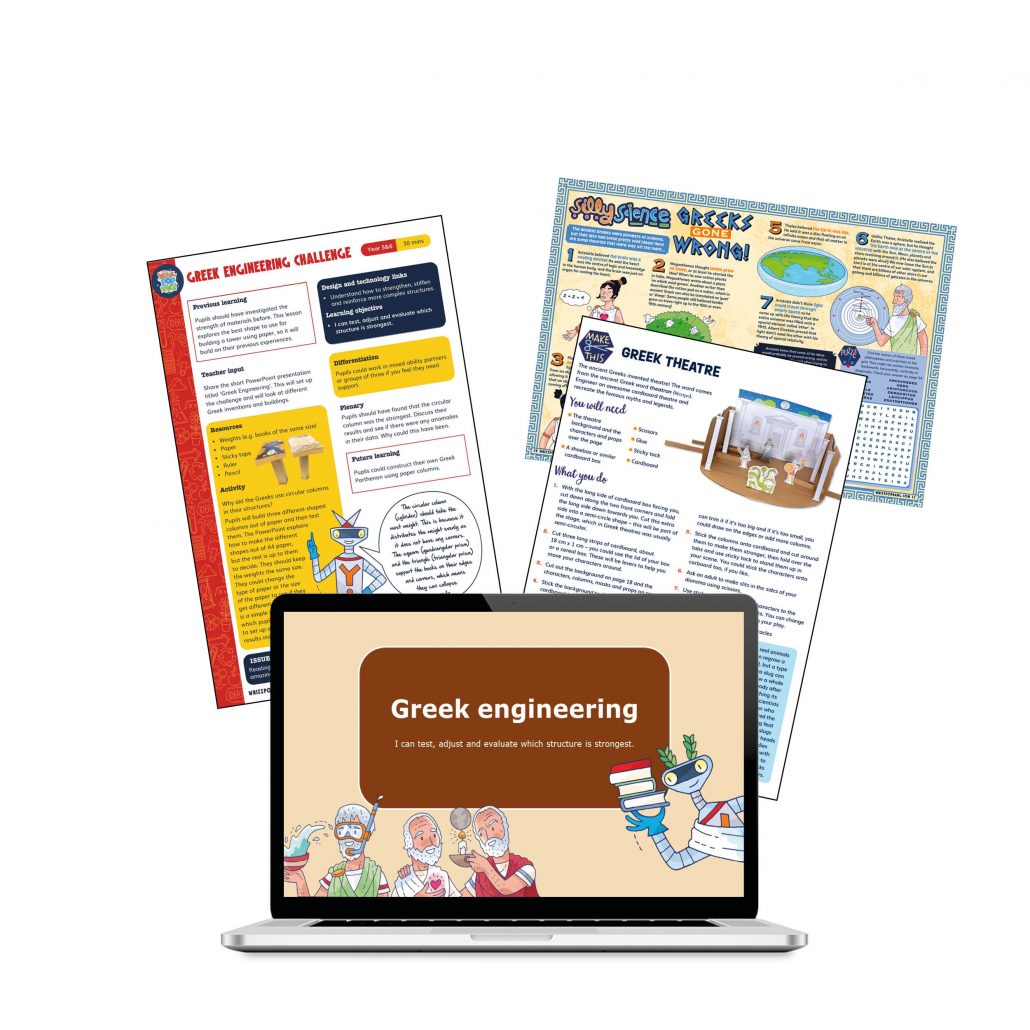
Are you looking for inspiring planning resources for teaching ancient Greece in upper key stage 2? Here’s how you can use our new downloadable ancient Greece teaching resources to easily create a memorable lesson …
Where to start?
Before you use the lesson pack, pupils should already know when the ancient Greek period was and they should be aware of the term engineering. This lesson pack links with history, design and technology and science. Therefore, it is a STEAM lesson.
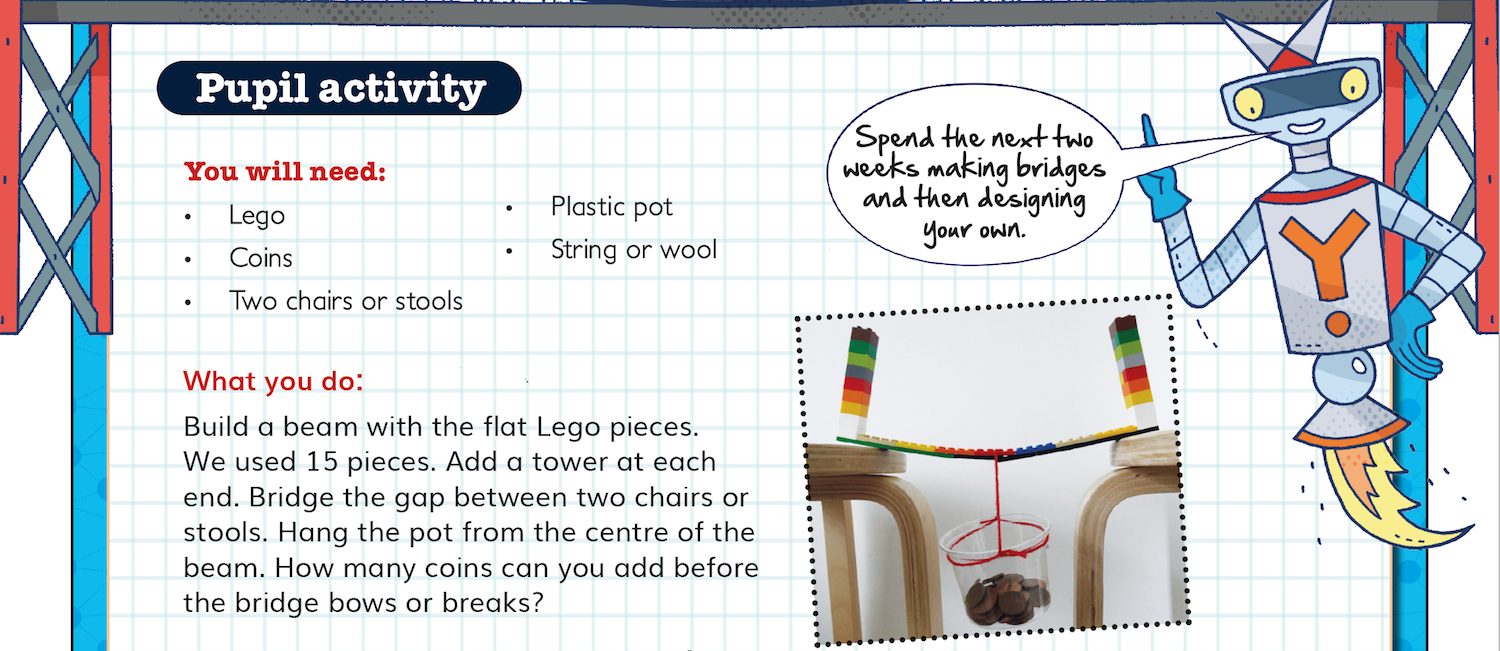
Pupils will carry out a simple experiment to see why the ancient Greeks chose to build with columns. They will test different shapes and see which is the strongest.
The downloadable pack includes:
A differentiated lesson plan
A PowerPoint presentation
A printable Greek theatre
A text explaining some ancient Greeks’ wild ideas!
Quality reading texts related to the ancient Greeks
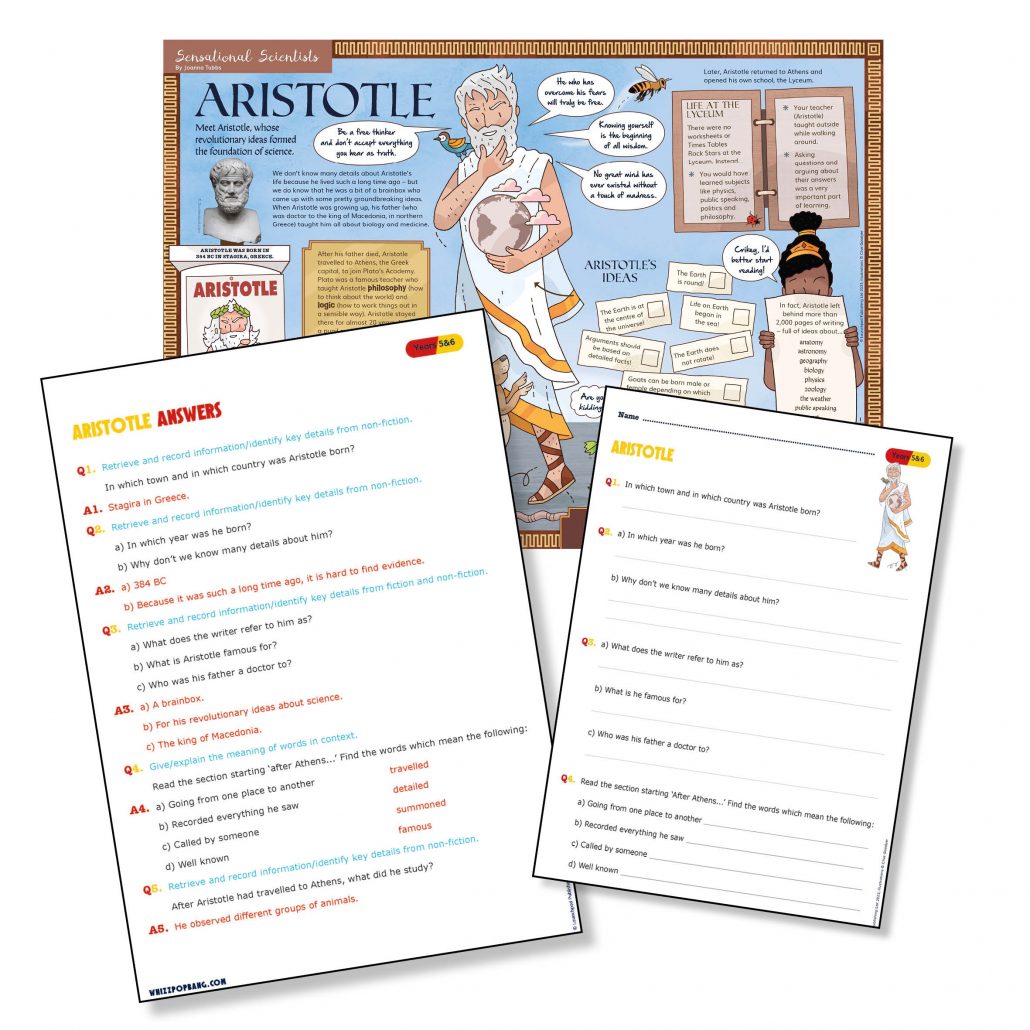
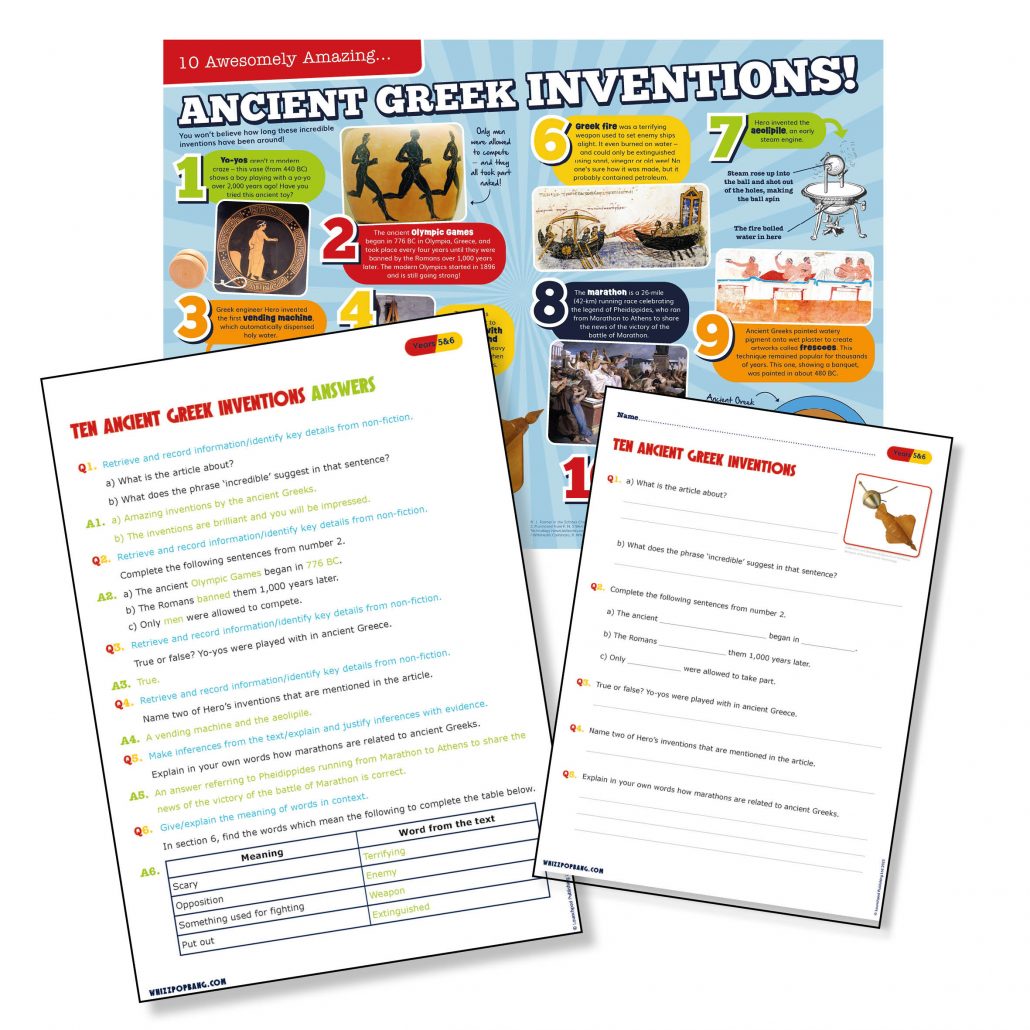
We have a whole issue dedicated to the ancient Greeks, which is full of fun facts and information suitable for primary-aged children. Our teachers have created three reading comprehensions with questions linked to the National Curriculum and Curriculum for Excellence:
Whizz Pop Bang magazine and teaching resources are brilliant ways to enhance your school’s science teaching:
We provide downloadable science lesson plans, PowerPoint presentations, hands-on investigations and science reading comprehensions written by primary school teachers.
Whizz Pop Bang teaching resources link to the National Curriculum, ensuring correct coverage.
All of our resources are year group specific, ensuring progression between the years.
We make cross-curricular links to other subjects, such as English, Maths, History, Geography, Art, Design and Technology and PSHE.
Prices from as little as £197.99 per year for a copy of Whizz Pop Bang magazine through the post each month and whole-school access to our ever-growing library of downloadable teaching resources, with unlimited teacher logins.
We’ve also launched a newindividual membership option so teachers and home educators can access all of our amazing downloadable resources for just £20 for the whole year.
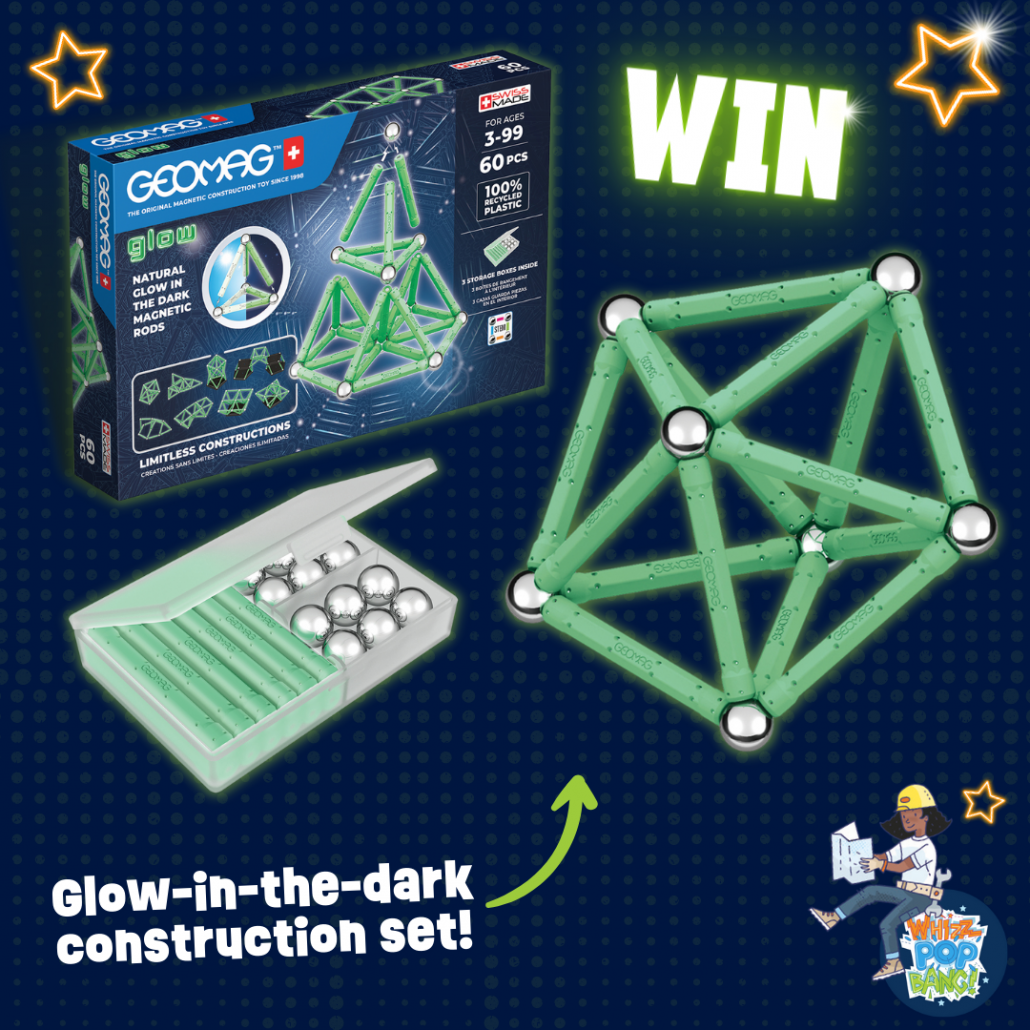
We’ve got three epic construction sets to give away from Geomag!
Enter our competition to be in for a chance to win a bumper 60-piece magnetic construction set from Geomag! This kit is sure to get mini-engineers excited about building 3D models because not only are they magnetic, but they also glow in the dark!
Use the strength and energy of the Geomag magnets and spheres to build crazy spinning tops and suspended models that will spin for ages. Put your building and spinning skills to the test with this Geomag Glow Magnetic Construction Set! Plus, they are environmentally friendly as all Geomag toys are made from recycled plastic!
For your chance to win, simply answer this question in the comments:
How tall is the Eiffel tower?
a) 30 metres b) 300 metres c) 3,000 metres
This competition closes at midnight on 28th February 2023. For full terms and conditions visit whizzpopbang.com/terms
Fill your child with science wonder with a subscription to Whizz Pop Bang, the award-winning magazine for 6 to 12-year-olds. Watch their face light up with glee when their very own magazine zooms through the letterbox! Packed full of hands-on science awesomeness, it’s the gift that keeps of delighting, month after month.
Scientists in Australia studying octopuses have found that one species, called gloomy octopuses, sometimes throw objects at each other! Here they are in action: