Magic Science Experiments for Kids – Whizz Pop Bang Issue 137 Kit List

Prepare to amaze your friends and family with some seriously spellbinding science!

Whizz Pop Bang Issue 137: Marvellous Magic Tricks is packed with easy magic tricks for kids, hands-on science experiments and mind-boggling optical illusions. Make water appear to disappear, make a coin jump, create a gravity-defying illusion and discover how to make a hole appear in your hand!

Best of all? These aren’t really magic tricks – they’re clever science experiments, perfect for curious kids aged 6–12 who love discovering something amazing!

Subscribe by 4th December 2026 to start your subscription with Marvellous Magic Tricks AND get a free science joke book + personalised goodies when you start a new 6- or 12-month subscription!

Easy magic tricks and science experiments to try at home

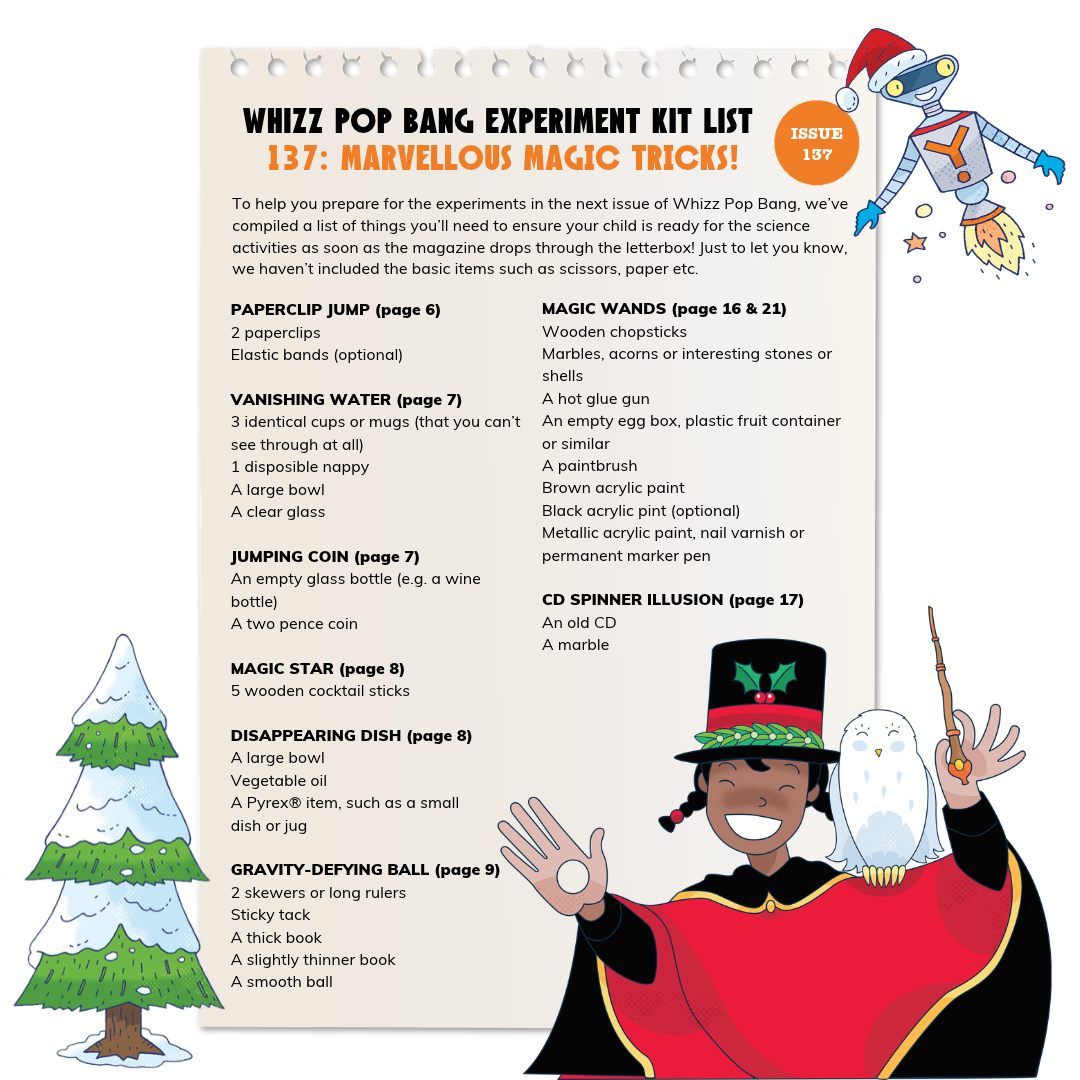
To help your child get stuck into the magical science as soon as their magazine arrives, we’ve put together this handy science magic experiment kit list.

Hopefully, you’ll have a lot of the equipment needed in your house already. We haven’t included basic stationery such as scissors, pencils and paper. Let the science show begin!
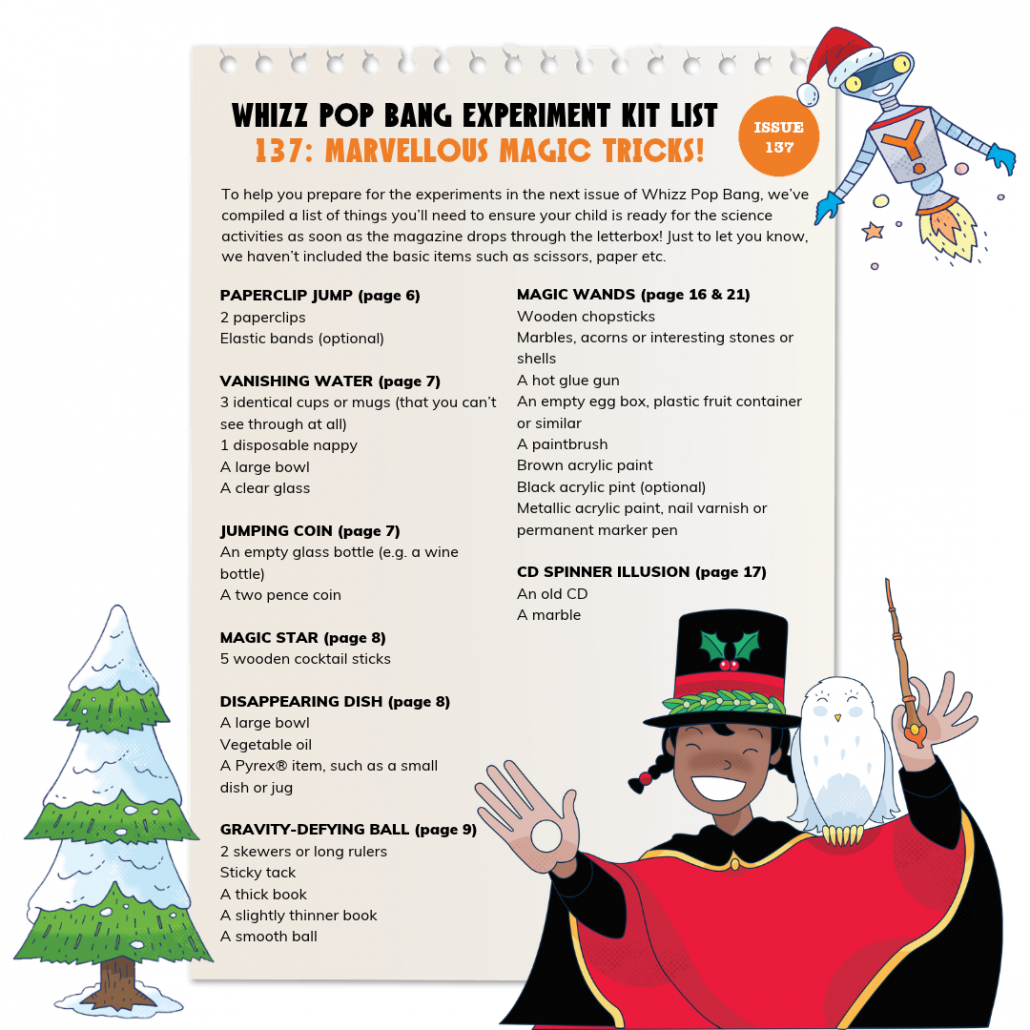
Want a printable version of this list to stick on your fridge? Click here!

What you’ll need for the experiments in Issue 137: Marvellous Magic Tricks!

🪄 Marvellous Magic – science tricks to amaze your friends (pages 6–11)

📎 Paperclip Jump – make paperclips magically link together

  • 2 paperclips
  • Elastic bands (optional)

💧 Vanishing Water – make water disappear into thin air

  • 3 identical opaque cups or mugs
  • 1 disposable nappy
  • A large bowl
  • A clear glass
  • A tablespoon

🪙 Jumping Coin – make a coin move

  • An empty wine bottle or similar-sized glass bottle
  • A two pence piece

⭐ Magic Star – conjure up a Christmas star

  • A plate
  • 5 wooden cocktail sticks

🫥 Disappearing Dish – make a glass dish seem to vanish

  • A large bowl
  • Vegetable oil
  • A Pyrex® item, such as a small dish or jug

⚽ Gravity-Defying Ball – make a ball appear to roll uphill

  • 2 skewers or long rulers
  • Sticky tack
  • A thick book
  • A slightly thinner book
  • A smooth ball

🌿 Emmi’s Eco Club (pages 16 and 21)

✨ Make Magic Wands

  • Wooden chopsticks
  • Marbles, acorns or interesting stones or shells
  • A hot glue gun
  • An empty egg box, plastic fruit container or similar
  • A paintbrush
  • Brown acrylic paint
  • Black acrylic pint (optional)
  • Metallic acrylic paint, nail varnish or permanent marker pen

💿 CD Spinner Illusion (page 17)

  • An old CD
  • A marble

There’s even more hands-on fun in this issue! Draw a 3D hand, make a mysterious möbius strip, see a hole appear in your own hand, amaze your family with mind-reading maths and much more.

Want more fun science activities for kids?

Every issue of Whizz Pop Bang is packed with exciting science experiments, fascinating facts, puzzles and creative activities to inspire curious children aged 6–12.

Subscribe to Whizz Pop Bang and your child can enjoy a completely new science adventure delivered through their letterbox every month!

Subscribe by 4th December 2026 to start with Marvellous Magic Tricks – and get a FREE Science Joke Book plus personalised Christmas goodies with a new 6- or 12-month gift subscription!

Download your free printable magic science experiment kit list

Want to get everything ready before the magazine arrives? Download our handy printable checklist and tick off the supplies as you collect them.

Don’t miss your chance to receive a FREE science joke book and personalised goodies when you purchase a 6- or 12-month subscription starting with Marvellous Magic Tricks!

Subscribe by 4th December 2026 and use the code XMAS26 to redeem this offer!


Post Comment

Why do some volcanoes explode? Try this easy volcano science experiment! 🌋

If you’ve got a 6–12 year old who’s always asking, “Why?”, this one’s for you!

This experiment explains exactly why some eruptions are so much more dangerous than others. Watch the reel to see it in action and hear an explanation of the science of magma. Save this for your home-education science lessons or for when you run out of ideas at the weekend! ​

Why do some volcanoes produce spectacular explosions, while others have rivers of lava flowing down their sides? The answer has a lot to do with what’s happening deep inside the volcano!

With this simple volcano science experiment for kids, you can investigate how different types of magma affect volcanic eruptions. All you need are a few everyday household materials – no complicated equipment required!

Watch our volcano experiment in action! 🎥

Bubble Trouble: A volcano science experiment

Some volcanoes contain magma that is runny and some contain much more viscous (gloopy) magma. Find out how different magmas affect volcanic eruptions.

You will need

  • A small glass half-filled with water
  • A small glass half-filled with golden syrup, honey or other viscous (gloopy) liquid
  • An outdoor space or plastic sheeting
  • Two straws
  • Safety goggles

What you do

  1. Protect your work surface and put on your safety goggles so your eyes don’t get splashed with spewing lava!
  2. Imagine that the water is runny magma below the surface of the Earth and that the gloopy liquid is viscous (thick) magma.
  3. Put a straw into each cup of lava and gently blow bubbles – first into runny magma (the water) and then into viscous magma (the gloopy liquid). Which is easier to blow into?
  4. Now try blowing really hard into each type of magma. What happens?

What’s the science behind it? 🔬

It’s hard to blow bubbles into the viscous magma; the bubbles come to the surface much more easily in the runny magma (water).

When you blow bubbles into the runny magma, you create lots of small bubbles that quickly and easily rise to the surface.

When you blow bubbles into the viscous magma, a large bubble builds up below the surface and then suddenly erupts, taking the gloopy magma up with it.

Similarly, real volcanoes that contain viscous magma erupt much more violently – and are so much more dangerous – than volcanoes that contain runny magma.

What makes a volcano erupt?

Deep beneath the Earth’s surface, molten rock called magma contains trapped gases.

As magma rises towards the surface, the pressure around it decreases and gas bubbles can form and grow.

If the magma is runny, the gases can escape relatively easily. But when magma is thick and sticky, gases can become trapped, building up pressure that can lead to an explosive eruption!

Did you know? When magma reaches the Earth’s surface, it’s called lava!

More amazing volcano science for curious kids!

Love volcanoes, eruptions and explosive science experiments?

Discover the fiery world of volcanoes in Whizz Pop Bang: Volcano Alert! It’s packed with fascinating facts, hands-on experiments and activities for children aged 6–12.

Find out what happens deep beneath the Earth’s surface, discover some of the world’s most extraordinary volcanoes and try even more volcanic science at home.

Or keep the discoveries coming with a Whizz Pop Bang subscription! Every month, our award-winning children’s science magazine brings exciting experiments, fascinating facts and hands-on activities straight through your letterbox.


Post Comment

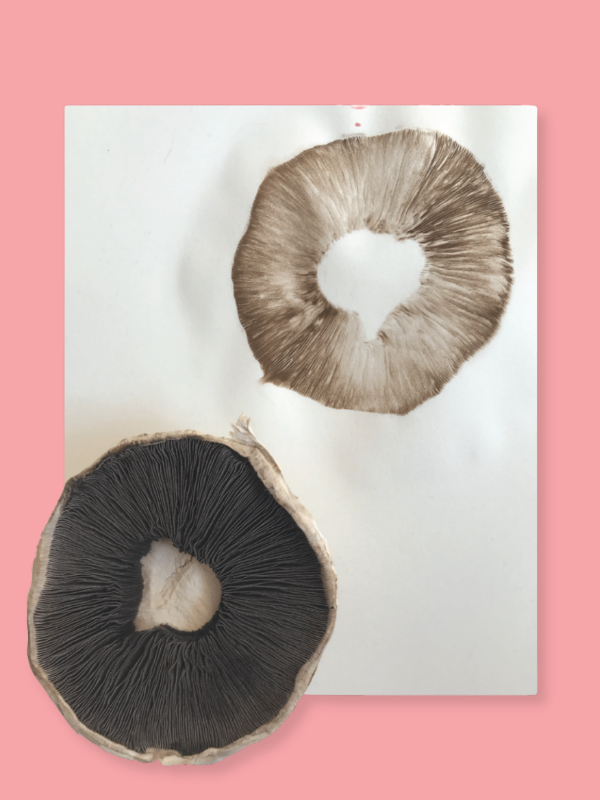
How to create a mushroom spore print

Did you know that mushrooms can make their own amazing patterns on paper? With just a mushroom and a few things from around the house, you can create a beautiful spore print and discover some fascinating fungi science!

This easy science experiment is perfect for curious kids who love exploring nature.

Watch: How to make a mushroom spore print

You will need:

  • A flat mushroom (use one bought from a food shop)
  • Plain white paper
  • A sprinkle of water

How to make your mushroom spore print

  1. Carefully remove the stalk from your mushroom to expose the gills underneath.
  2. Lay your mushroom, gill side down, onto the paper.
  3. Sprinkle with a bit of water
  4. Cover it with a bowl to stop the mushroom drying out or being disturbed.
  5. Leave it undisturbed for two days.
  6. Remove the bowl carefully then lift the mushroom off the paper to reveal your spore print!

Here’s the science…

Did you know that fungi and mushrooms don’t have seeds? Instead, they release tiny spores that look like powder or dust. The cap of the mushroom opens up and releases them from its gills. The spores blow away in the wind to grow into new fungi. In this experiment, you can catch those spores and turn them into a beautiful print.

Keep the science adventures coming…

…with a subscription to Whizz Pop Bang, the award-winning science magazine for children aged 6 to 12. Every issue is packed with experiments, discoveries and activities to try at home.

Subscribe to Whizz Pop Bang


Post Comment
Child cleaning old coins in a vinegar and salt science experiment

Gleaming Coins Experiment: Make Dirty Coins Shine with Chemistry!

Learn how to make dirty coins shine with this easy chemistry experiment for kids! Using vinegar and salt, discover the science of oxidation in just a few minutes.

Have you ever wondered why old coins lose their shine?

With just vinegar, salt and a few grubby coins, your child can become a mini chemist and discover the science behind oxidation in just a few minutes.

This quick experiment is perfect for curious children and uses everyday kitchen ingredients to reveal an amazing chemical reaction.

Watch the experiment

Watch our short video below to see the gleaming coins experiment in action.

You’ll need

  • A glass jar
  • 200ml white vinegar
  • 1 teaspoon of salt
  • Some grubby 1p or 2p coins
  • Paper towels
  • Running water

What happens?

When copper coins are exposed to air over time, they react with oxygen to form a dull layer called copper oxide.

Mixing vinegar (a weak acid) with salt creates a solution that dissolves this oxide layer, revealing the shiny copper underneath.

It’s a brilliant way to introduce children to the idea that chemistry is happening all around us—even on the loose change in your pocket!


The science behind it

Copper naturally reacts with oxygen in the air.

This reaction forms a coating called copper oxide, which makes the coin look brown and dull.

The acetic acid in vinegar helps loosen this layer, while the salt speeds up the reaction. Once the oxide has dissolved away, the shiny copper beneath is revealed.

Although it looks like magic, it’s actually chemistry!


Questions to ask your young scientist

Can you predict which coin will become the shiniest?

Why do you think older coins look dirtier than newer ones?

What happens if you leave the cleaned coin out in the air again?

Can you think of any other metal objects that change colour over time?


Safety

This experiment should be carried out with adult supervision.

Wash hands after handling coins and avoid drinking the vinegar solution.


Keep the science going!

If your child loved this experiment, they’ll love Whizz Pop Bang magazine.

Every month is packed with exciting experiments, fascinating facts, puzzles and hands-on STEM activities designed for children aged 6–12.

👉 Explore Whizz Pop Bang subscriptions here.


Post Comment

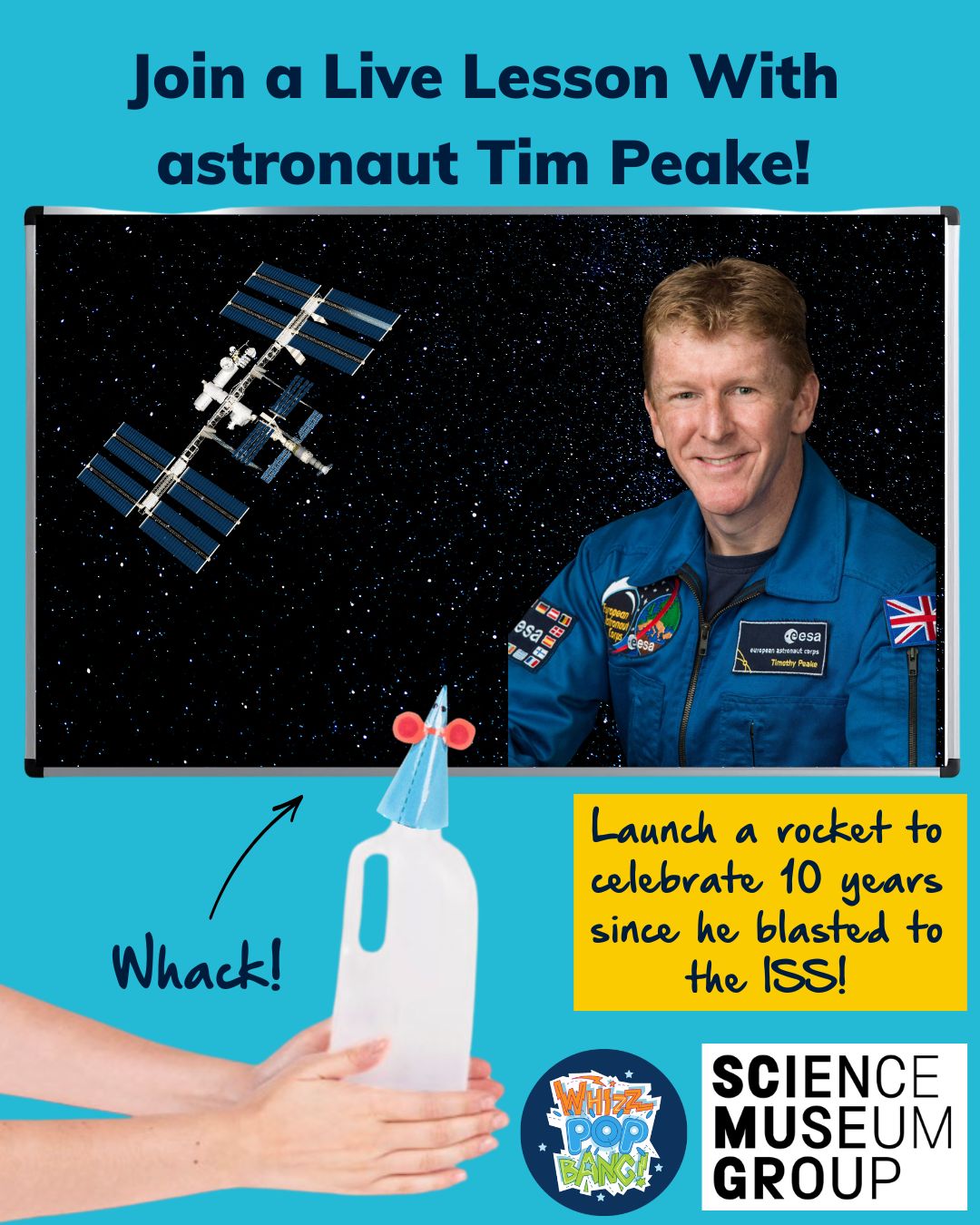
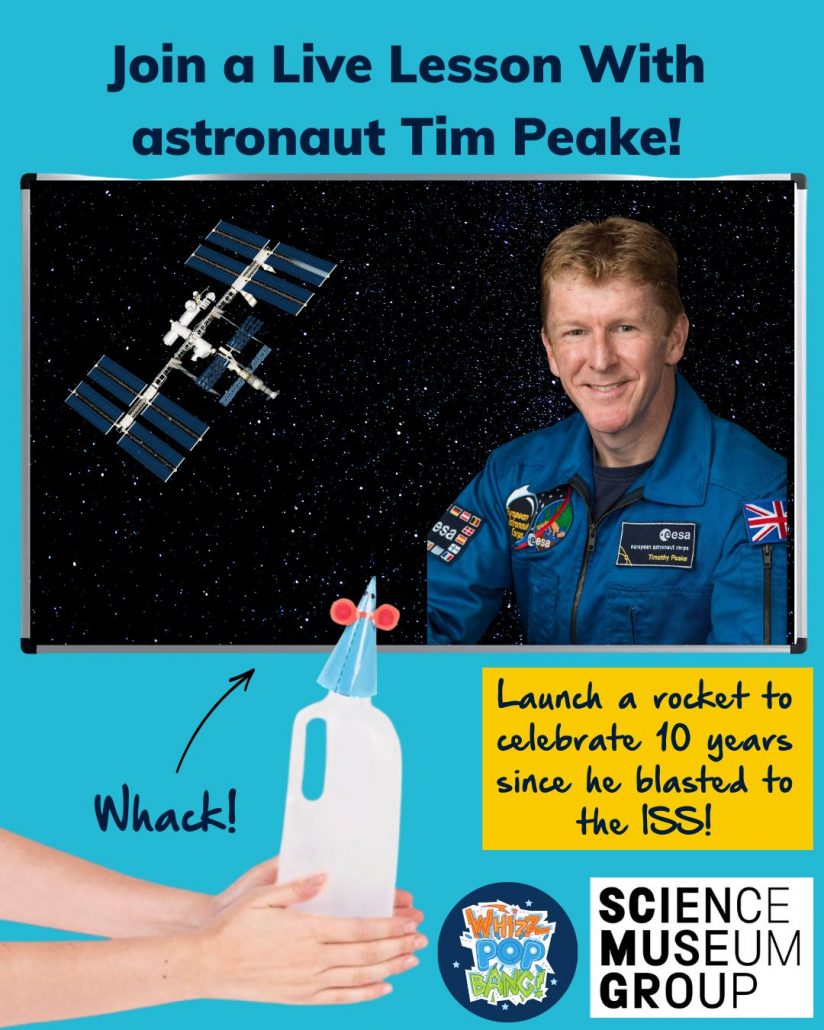
Break a record and join a live lesson with Tim Peake!

Want to print rocket templates straight away? They’re here!

It’s 10 years since astronaut Tim Peake’s mission to the International Space Station launched…

To celebrate, kids across the UK are invited to join in a lesson with Tim. Broadcast live from the Science Museum at 10:20 am on the 15th of December, it will feature a mass paper rocket launch to mark the exact moment (at 11:03) that Tim blasted off into space a decade ago! Ask your teacher or parent to sign up here.

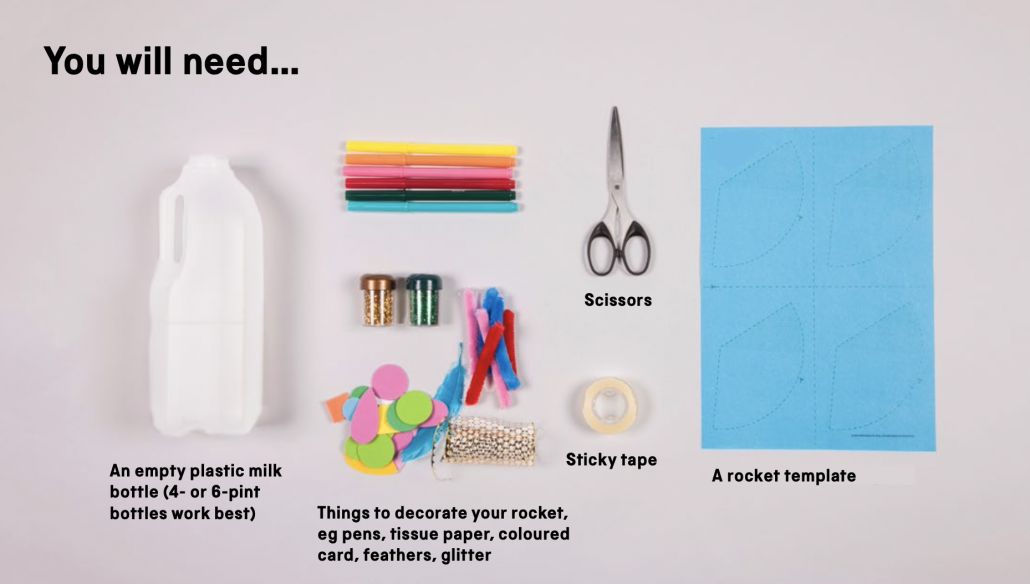
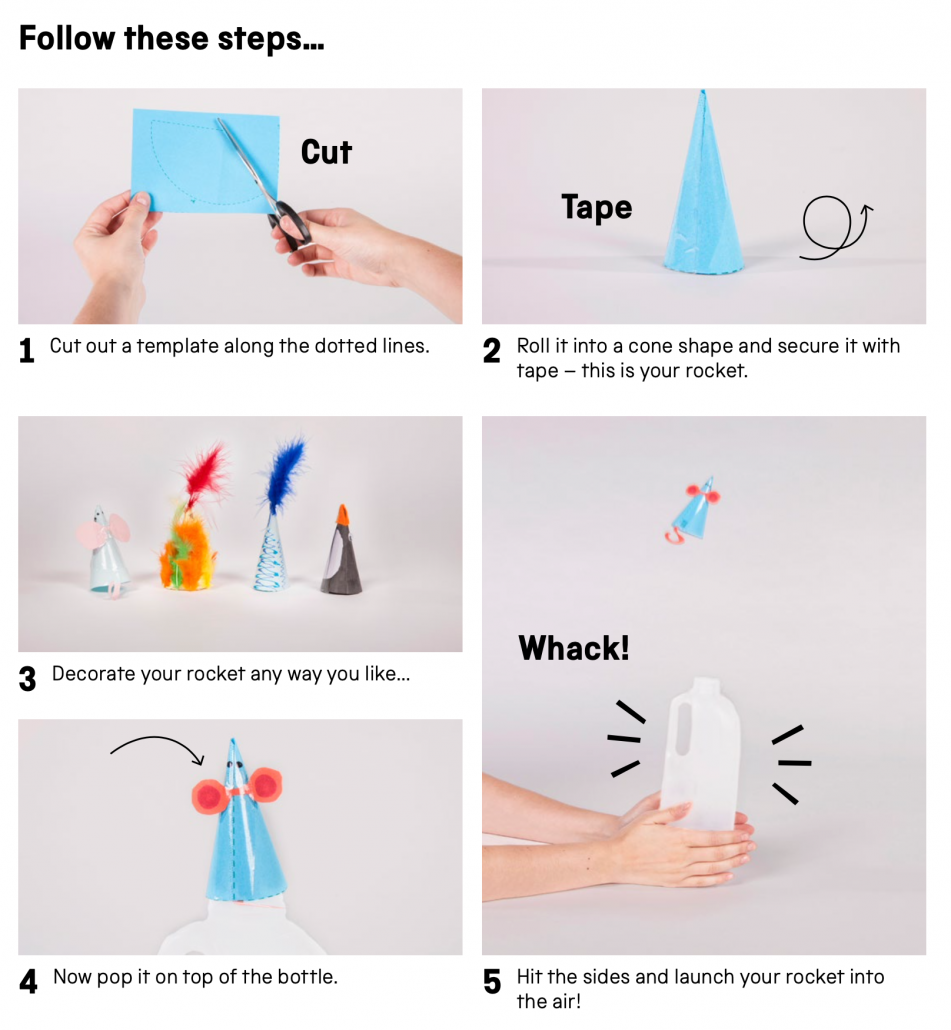
You can print the instructions and find templates for making your own rocket here: 

or read the information and instructions here, then download the templates only afterwards.

Overview for adults

There’s an old saying: what goes up must come down. This activity is a perfect chance to challenge that idea, shooting a rocket high into the air by rapidly squashing a plastic bottle launcher. You’ll never get this rocket into space – but some real rockets do go fast enough to prove the saying wrong.

What’s the science?

The bottle used as the rocket launcher is not really empty: there is air inside it. Air is elastic (squashy), and when you compress it, it pushes back and the pressure inside increases. In the activity, the sudden increase in air pressure inside the bottle pushes hard on the bottom of the rocket, sending it flying high into the air. There are also two other forces acting on the rocket: air resistance and gravity. Air resistance always pushes in the opposite direction to the rocket’s movement, and its strength depends on the rocket’s shape and its speed. Gravity always pulls downwards, slowing the rocket’s climb but speeding up its descent.

Science in your world

Just as increasing the air pressure in the bottle sends the rocket flying, you use air pressure when you squeeze shampoo or ketchup from a plastic bottle. It’s not usually as exciting as watching the rocket shoot into the air in the activity… unless you’re having a food fight!

Did you know…?

In order to keep going straight upwards and never fall down again, a rocket must reach a speed called escape velocity, which is 11.2 kilometres per second.

Think and talk about…

• What makes your rocket fly?
• What makes it come down again?
• How do you think a real rocket works?

Investigate…

• How could you make your rocket travel higher?
• How could you make your rocket go more slowly?
• Can you make your rocket spin as it falls?

Science in your world

Just as increasing the air pressure in the bottle sends the rocket flying, you use air pressure when you squeeze shampoo or ketchup from a plastic bottle.

Here’s a printable page of rocket templates:


Post Comment

Halloween science experiments!

Are you looking for some spooky science to do at home? If you want to know how to do some Halloween experiments and make DIY Halloween decorations, you’ve come to the right place.

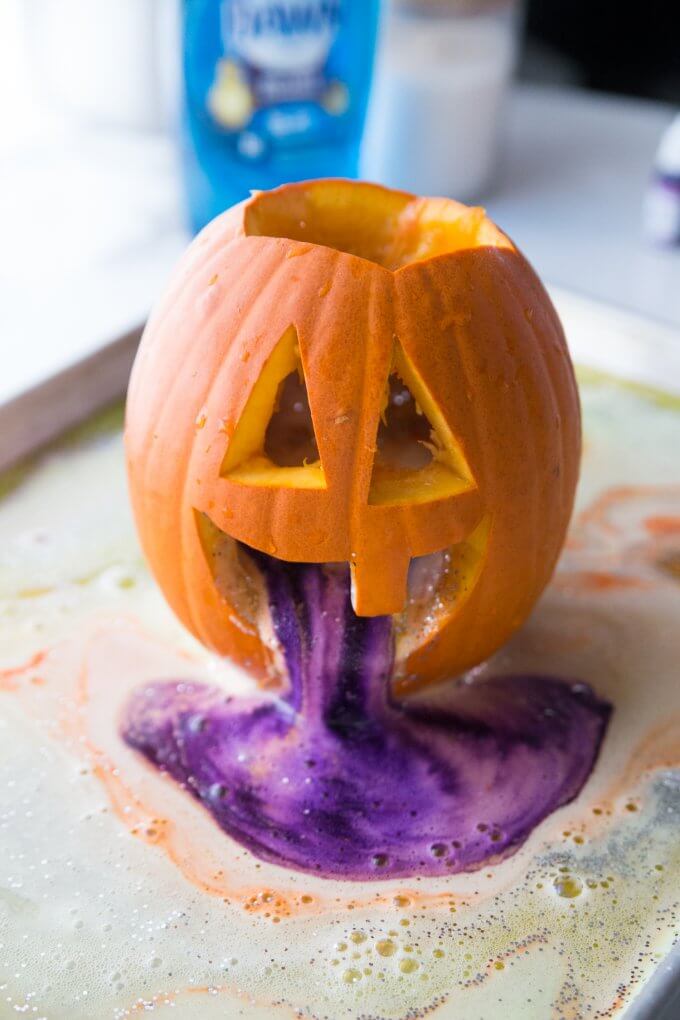
Discover how to create edible fake blood, craft a spooky window scene, turn Halloween candy into dancing Franken-worms, mix up a batch of gooey oobleck slime and carve a puking pumpkin right here.


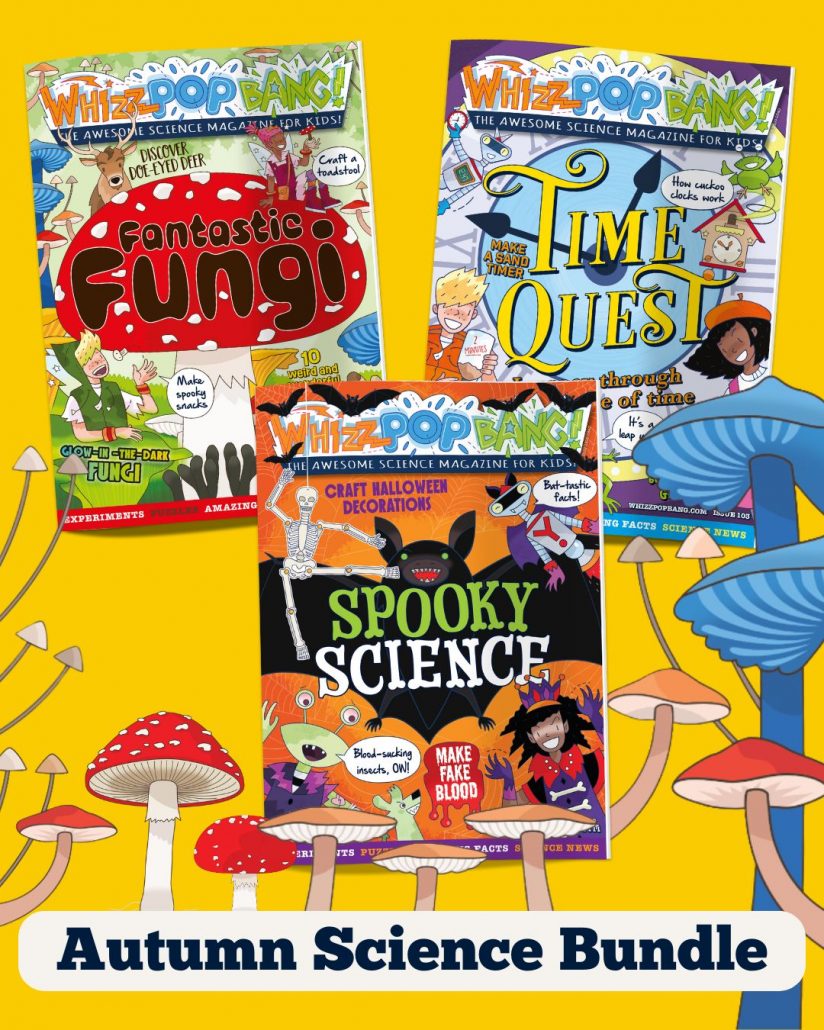
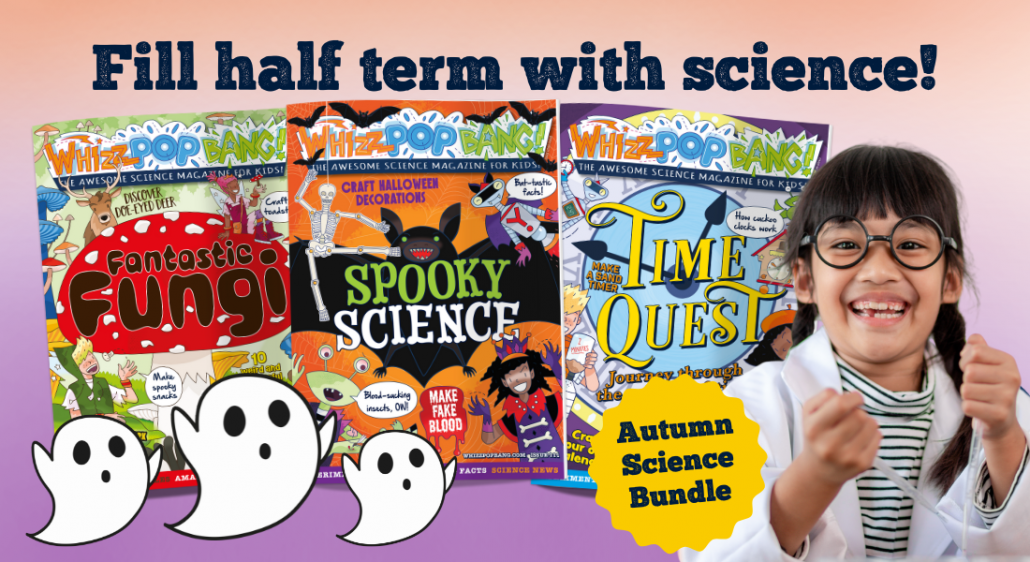
In Whizz Pop Bang’s Autumn Science bundle, mini scientists can…
👻 Dive into a world of blood-curdling fun in Spooky Science, make edible fake blood, blood cell cereal and working model heart and more!

🍄 Discover all sorts of weird and wonderful fungi in Fantastic Fungi! Make mushroom-spore artwork, craft model mushrooms, experiment with feeding yeast fungi and more.

⏰ Explore some time conundrums in Time Quest! Play silly 60-second games, discover how cuckoo clocks work, meet an spacetime astrophysicist and so much more!


Whizz Pop Bang is our award-winning science magazine that brings science to life for children aged six to twelve (and their parents too)!

Discover how easy it is to enjoy science at home with Whizz Pop Bang magazine. Spark your child’s imagination with lab-loads of hands-on experiments, the latest science news, tantalising puzzles and amazing facts.

Subscribe today to start your child’s adventures in discovery and to inspire the scientists of the future!


https://www.science-sparks.com/pumpkin-lava-lamps/

1. Pumpkin Lava Lamp

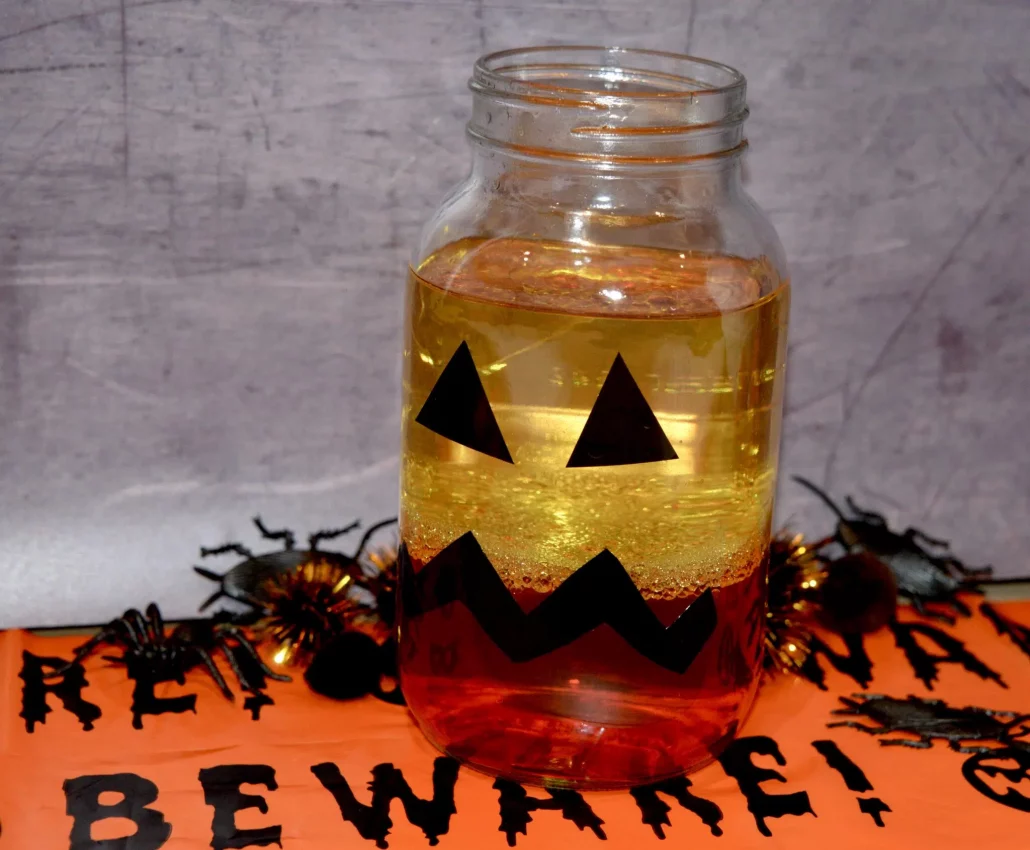
This brilliant activity by Science Sparks uses common kitchen ingredients to make a bubbling pumpkin laval lamp.

You will need:
A clear bottle or jar
A bottle of vegetable oil
Orange food colouring
Glitter
Water
Alka Seltzer (or try fizzy vitamin tablets)
Black pen and pipe cleaners for decoration

Head over to Science Sparks to find out how to make this epic lava lamp!


2. Spooky window scene

You will need:
A pencil
Black card or paper
Scissors
Translucent sweet wrappers or coloured tissue paper
Sticky tack
Battery operated tea lights

What you do:

  1. Draw your design on black card or paper.
  2. Cut it out.
  3. Add the windows and cut them out.
  4. Use see-through sweet wrappers or tissue paper as window panes.
  5. Add finishing touches (we cut out bats and ghosts!)
  6. Use sticky tack to stick to a window. Add battery operated lights to make your scene glow!


3. Dancing Franken-worms

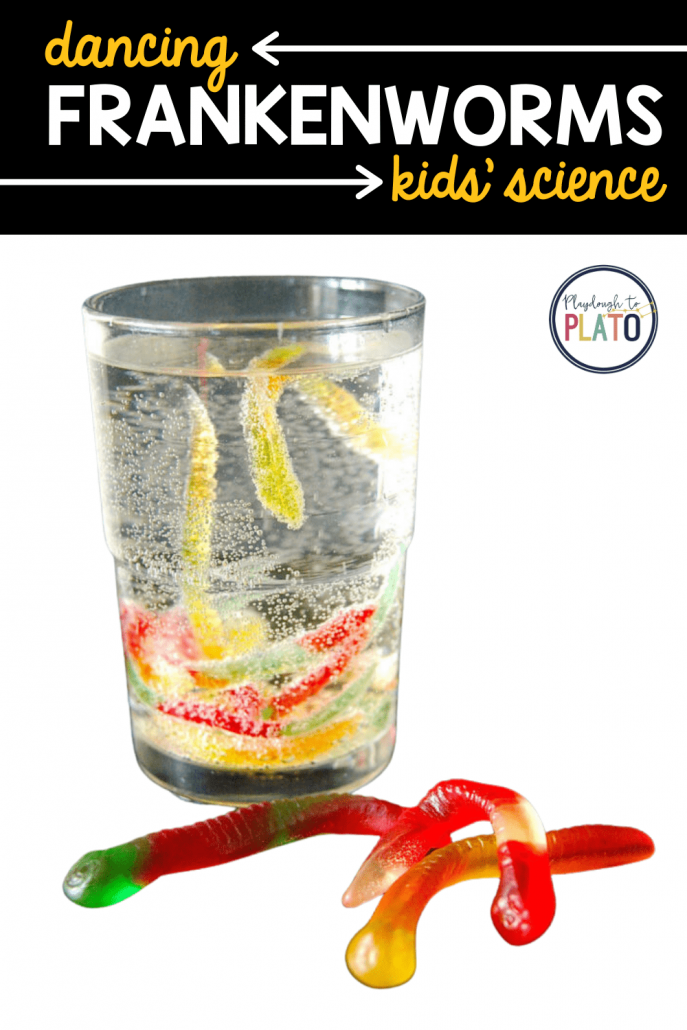
Turn the contents of those overflowing trick or treat buckets into a fun learning opportunity. Find out how to use bicarbonate of soda and vinegar to make gummy worms dance over at Playdoh to Plato’s blog!


Fill half term with science with the Autumn Science Bundle!


4. Ooey Gooey Oobleck

Find out how to make the freaky non-Newtonian fluid, oobleck! It’s a great Halloween science activity (and it’s easy to clean up!)

You will need:
Mixing bowl
Spoon
Cornflour or custard powder
Water
Food colouring (optional)

What you do:
1. Place four heaped tablespoons of cornflour or custard powder into a bowl.
2. Add a splash of water and stir the mixture. Keep adding water a little at a time, until the mixture is about the same consistency as honey.
3. If you add too much water, add some more cornflour or custard powder.
4. Add a little food colouring if you like and mix it in.

Watch the video to find out more about the strange properties of this special substance.


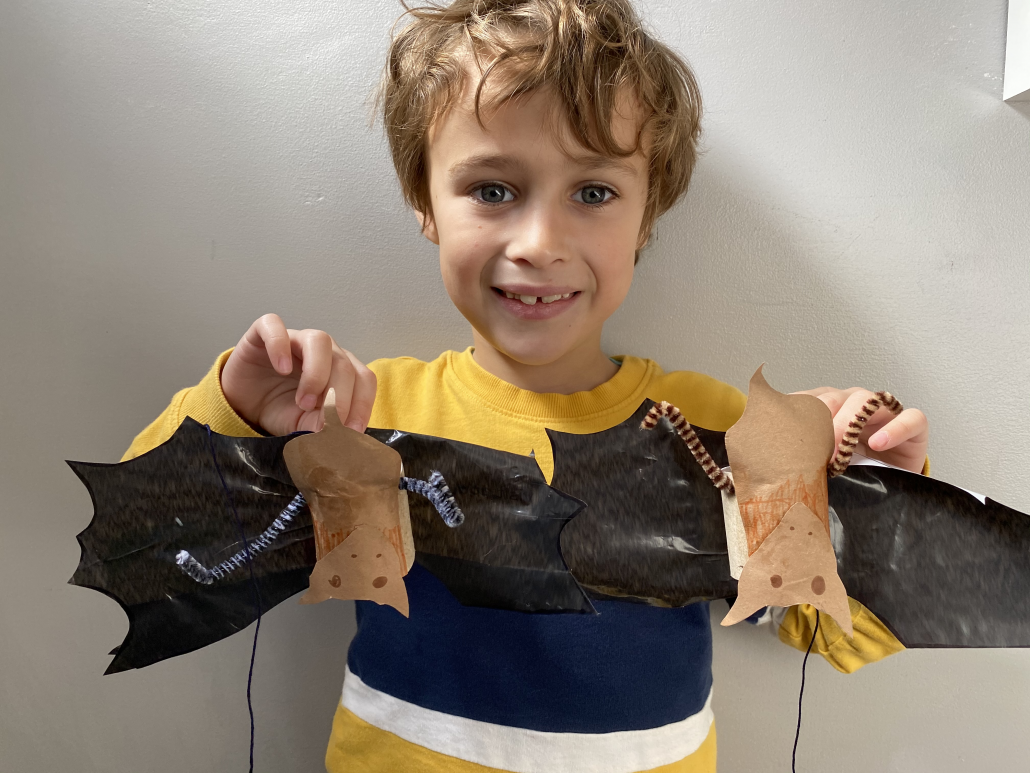
Thanks to Henry, aged 7, for sending in pictures of his brilliant bats!

5. Puking Pumpkin Experiment

You’ve carved a pumpkin – now use science to make it even more fun with this brilliant idea from Little Bins for Little Hands! Click here for step-by-step instructions

Looking for more home science fun? From science experiments, science activities, collectible science club badges to science colouring and more, you’ll find loads of brilliant ideas right here!


Post Comment

Watch dancing cornflour!

When cornflour is mixed with water, it becomes a goo that flows like a liquid until it is hit or pressed – then it acts like a solid. Watch the video below to find out what happens if cornflour is placed on a speaker that is vibrating and making sound waves.

The cornflour goo is getting continually hit by the vibrating speaker, making these weird and wonderful dancing cornflour figures!

This cornflour and water mixture is sometimes called oobleck, and you should definitely try playing with it at home! Here’s a recipe for how to make this slime-like substance…

You will need:
Mixing bowl
Spoon
Cornflour or custard powder
Water
Food colouring (optional)

What you do:
1. Place four heaped tablespoons of cornflour or custard powder into a bowl.
2. Add a splash of water and stir the mixture. Keep adding water a little at a time, until the mixture is about the same consistency as honey.
3. If you add too much water, add some more cornflour or custard powder.
4. Add a little food colouring if you like and mix it in.

Watch the video to find out more about the strange properties of this special substance.


Post Comment

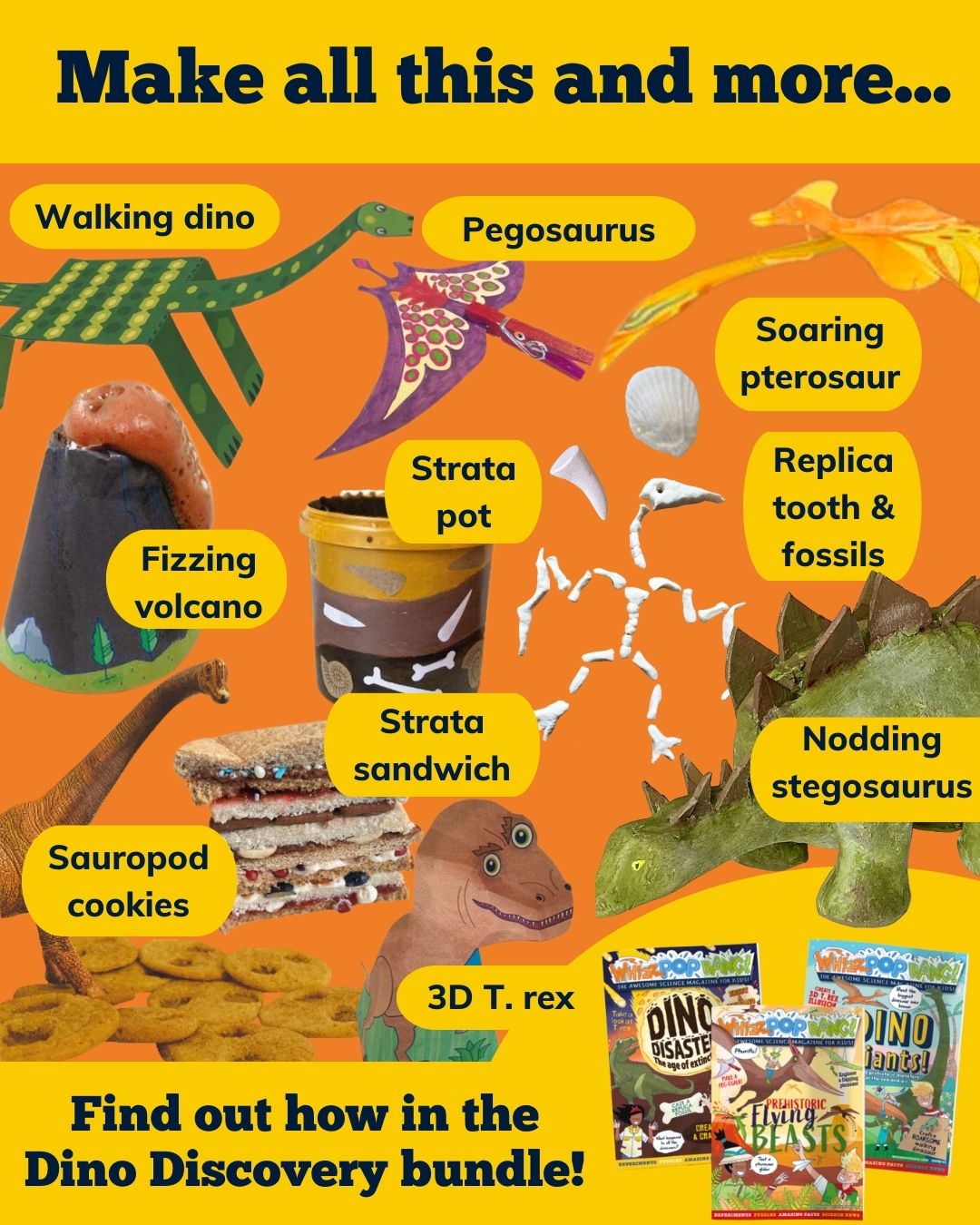
Explore the Prehistoric World with Whizz Pop Bang’s Bargain Bundle Of Dinosaur Magazines!

Spark their imagination with the Dino Discovery Bundle—a fantastic set of three dinosaur-packed magazines! This exciting collection of prehistoric puzzles, hands-on activities and fascinating facts will inspire any young dino fan.

Did you know that Whizz Pop Bang’s bargain bundles of back issues are a great way of giving the awesome science magazine for kids a try?
Three issues – £14.99 (that’s just £4.99 per issue!)
Six issues – £27.99 (that’s £4.66 just per issue!)
Twelve issues – £49.99 (that’s just £4.16 per issue!)
PLUS ALL PRICES INCLUDE FREE UK P&P!

🌟 What’s Inside the Dino Discovery Bundle?

Your young explorer will have the chance to make, discover, and investigate incredible prehistoric wonders!

🛠️ Make…

Encourage hands-on learning with fun dinosaur-themed activities that help kids explore the science behind these ancient creatures!
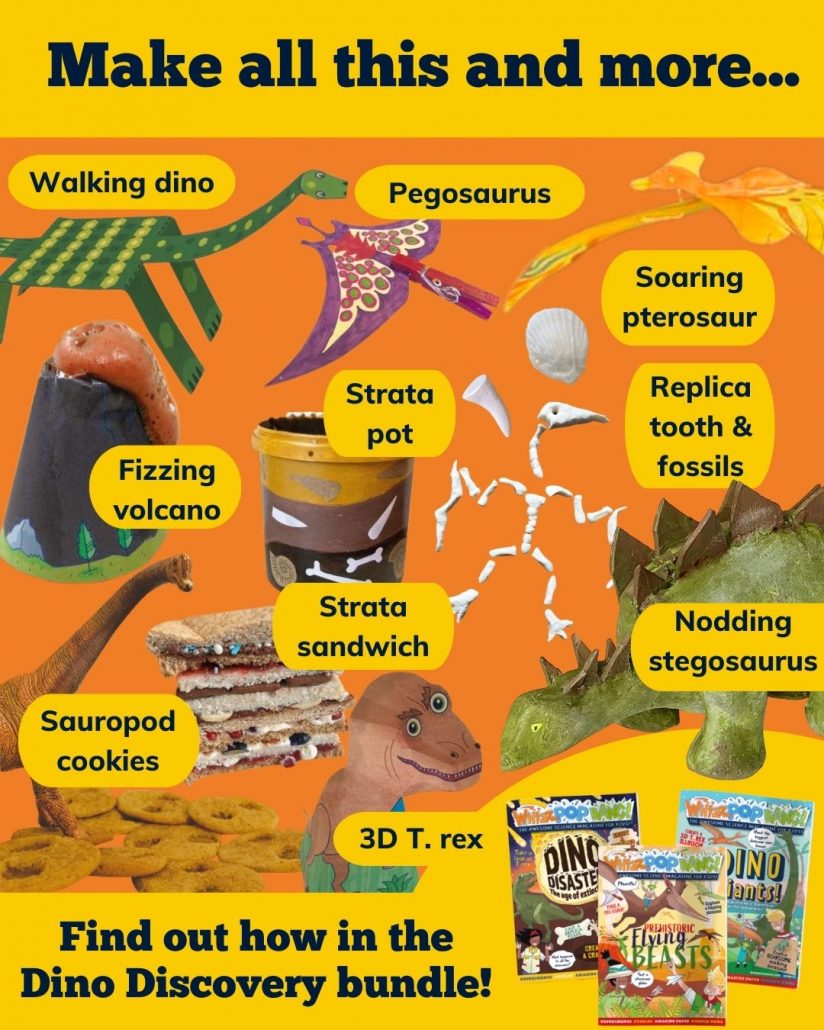
🦕 Fold a walking paper dino
🦕 Craft a pegosaurus
🦕 Bake sauropod footprint cookies
🦕 Erupt a fizzing volcano
🦕 Cut and stick a 3D T. rex that appears to follow you around!
🦕 Make a strata pot
🦕 Model replica teeth, bones and shells
🦕 Create a nodding stegosaurus
🦕 Fly a soaring pterosaur

🔍 Discover…

Your child will uncover mind-blowing dino facts, including:
🦕 The link between dinosaurs and birds
🦕 Did dinosaurs fart themselves to extinction? (Yes, really!)
🦕 Pterosaurs that were as big as aeroplanes
🦕 Dinos taller than houses
🦕 Terrifying sea predators that ruled prehistoric oceans
🦕 What life in the Cretaceous period might have been like

🧐 Investigate…

Your little scientist will dive into fascinating experiments, learning:
🦕 How pterosaur crests may have helped them fly
🦕 The science behind gliders and how they soar without engines
🦕 How asteroid and meteorite craters form
🦕 What happened to plants after the asteroid impact that wiped out the dinosaurs

More Exciting Science Bundles Available!

Looking for more educational fun? Explore our bargain magazine bundles packed with STEM experiments, space adventures, and prehistoric discoveries!


Post Comment

Watch a Christmas chain fountain video!

🎄 Watch a chain of beads flow upwards and out of a glass – this is surely the most fun you can have with your Christmas decorations! Every year, our children look forward to this moment almost as much as the big day itself!

🎄 You’ll notice that the chain arcs over the rim of the glass, going upwards, before being pulled downwards. So how does it work? This is a cool physics problem to ponder! It happens because the chain acts like lots of connected little rods. When you pick up one end of a rod, that end of the rod goes up, and the other end tries to go down. However, if the downward force is stopped by the pile of beads below it, there is a small kickback, and the rod is pushed upwards. That upwards thrust at each link in the chain is what makes the chain rise. This is an easy activity to try for yourself at home! Just make sure that you feed the chain gradually into the glass from one end so that it doesn’t get into a tangle when it’s flowing out. You could experiment with letting the chain fall from different heights (for example by standing on a step compared to sitting down) to see if that makes a difference to the height that the chain reaches.

🎄 Have you ever seen a chain fountain in action before? Watch a Mould effect video, otherwise known as a chain fountain phenomenon video here! It’s the perfect simple science experiment to try at home!

Special Christmas Offer

Use coupon code: XMAS23

For a limited time, whilst stocks last, we’ll send you a FREE copy of the 100th edition of Whizz Pop Bang when you purchase a new subscription using the coupon code XMAS23.

Free science magazine and gift card

Imagine how excited your child will be to receive all of this on Christmas Day…

• Our movie edition ‘LIGHTS, CAMERA, ACTION!‘ as your first magazine

• FREE copy of the ‘SCIENCE PARTY‘ magazine!

• FREE gift card printed with your message to the child

• FREE festive packaging

Plus, your child will receive a magazine addressed to them through the letterbox every month!

Each month will bring a whole new world of excitement, with topics like Ancient Greeks, Outer Space, Bees, Aliens, Rainforests and Medicines.

HURRY! Order by midnight on 17th December for your items to be dispatched by Royal Mail’s last posting date for Christmas. This offer ends on 20th December or until stocks last. Place your order today to make sure your child doesn’t miss out.

Use coupon code: XMAS23

At the checkout, when asked ‘When would you like your subscription to start?’ select ‘Delivery as soon as possible‘.

* Christmas offer only valid on new 6 and 12-monthly subscriptions using the code XMAS23. At the checkout, when asked ‘When would you like your subscription to start?’ select ‘Delivery as soon as possible.’ Order by midnight on 17.12.23 for your items to be dispatched by Royal Mail’s last posting date for Christmas. Offer valid while stocks last or until midnight on 20.12.2023. Don’t forget to use the code XMAS23 at the checkout. Not valid in conjunction with any other offers.


Post Comment

COMPETITION CLOSED – WIN a Mega Connetix Creative Pack

We’ve got THREE bumper sets to give away from Connetix worth £115 each!

We have an epic giveaway this December, this is not one you want to miss out on! We’ve partnered with Connetix and have three massive, 120 piece magnetic construction sets to give away.

The Connetix 120 Piece Pastel Creative Pack makes playtime engaging and educational, sparking boundless creativity and promoting educational, playful experiences for children of all ages. This amazing creative pack offers a spectrum of shapes in 8 delightful pastel colours, making it the perfect canvas for constructing impressive Connetix creations, from intricate designs to grand-scale masterpieces.

Whether children are absorbed in solitary play or engaging with friends and family, constructions toys like this one from Connetix spark STEAM (Science, Technology, Engineering, Arts and, Mathematics) learning while nurturing fine and gross motor skills. Kids can assemble towering castles, futuristic rockets, majestic towers, sturdy bridges, and much more.

The high-quality, open-ended pack seamlessly adapts to your child’s evolving interests and abilities, providing a platform for increasingly complex and imaginative play experience

For your chance to win, simply answer this question in the comments:

Which is the tallest building in the world?

a) The Shard
b) Eiffel tower
c) Burj Khalifa

This competition closes at midnight on Sunday 31st December 2023 and is open to UK residents only. Whizz Pop Bang competition terms and conditions are here.


Post Comment