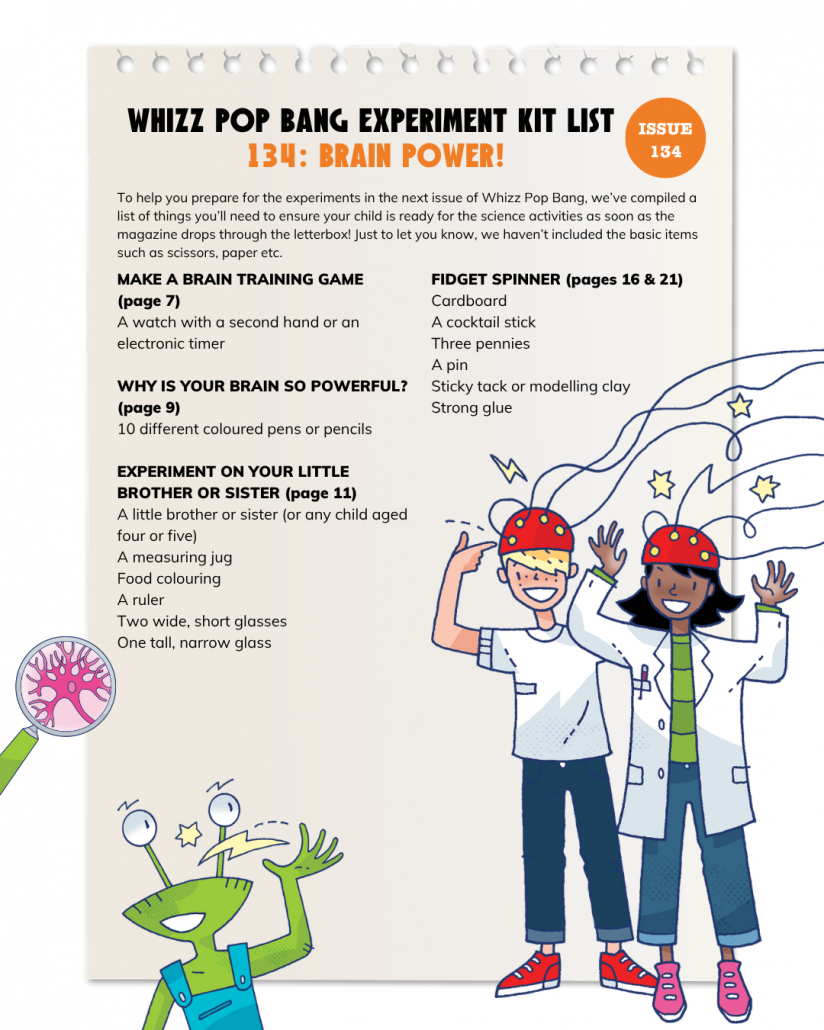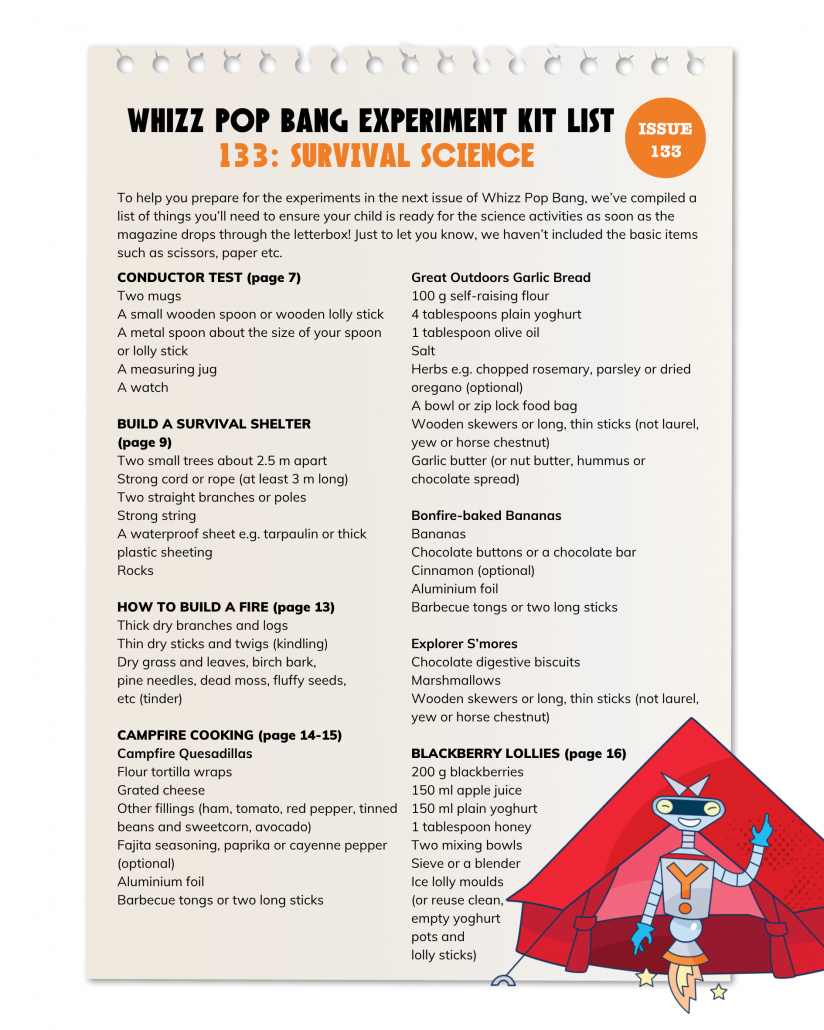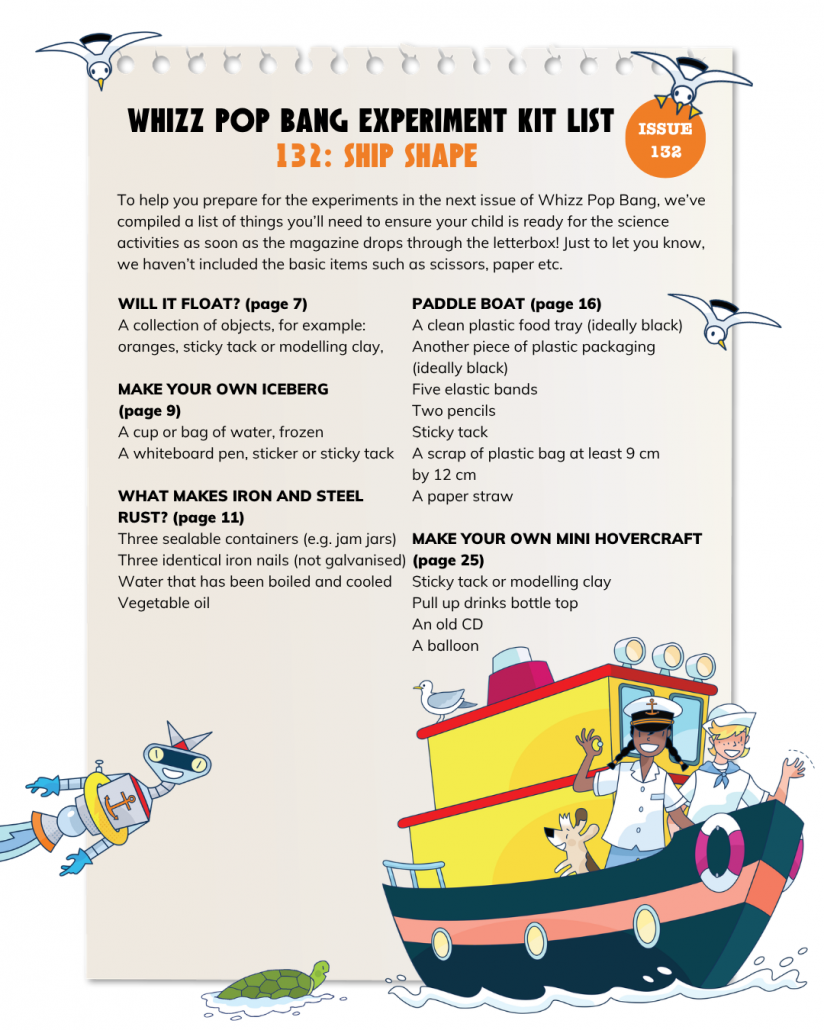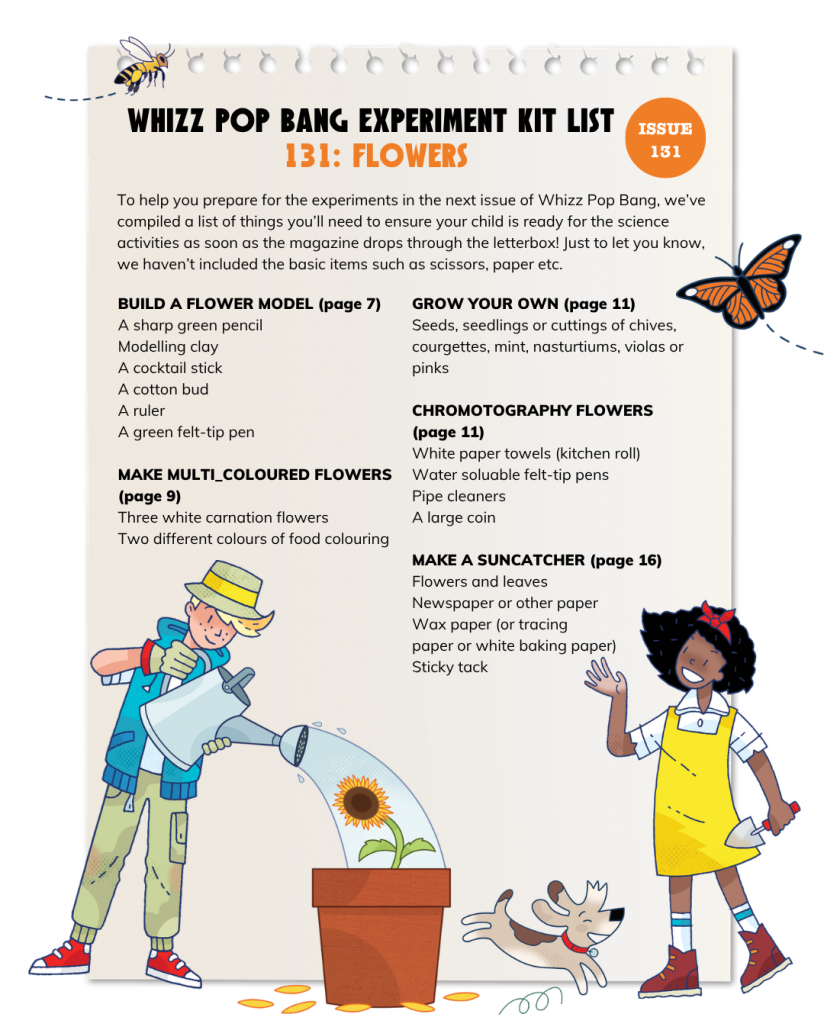
You’ll never look at flowers the same way again… Get ready for a blooming brilliant adventure through the wonderful world of flowers in Whizz Pop Bang’s flowers issue.
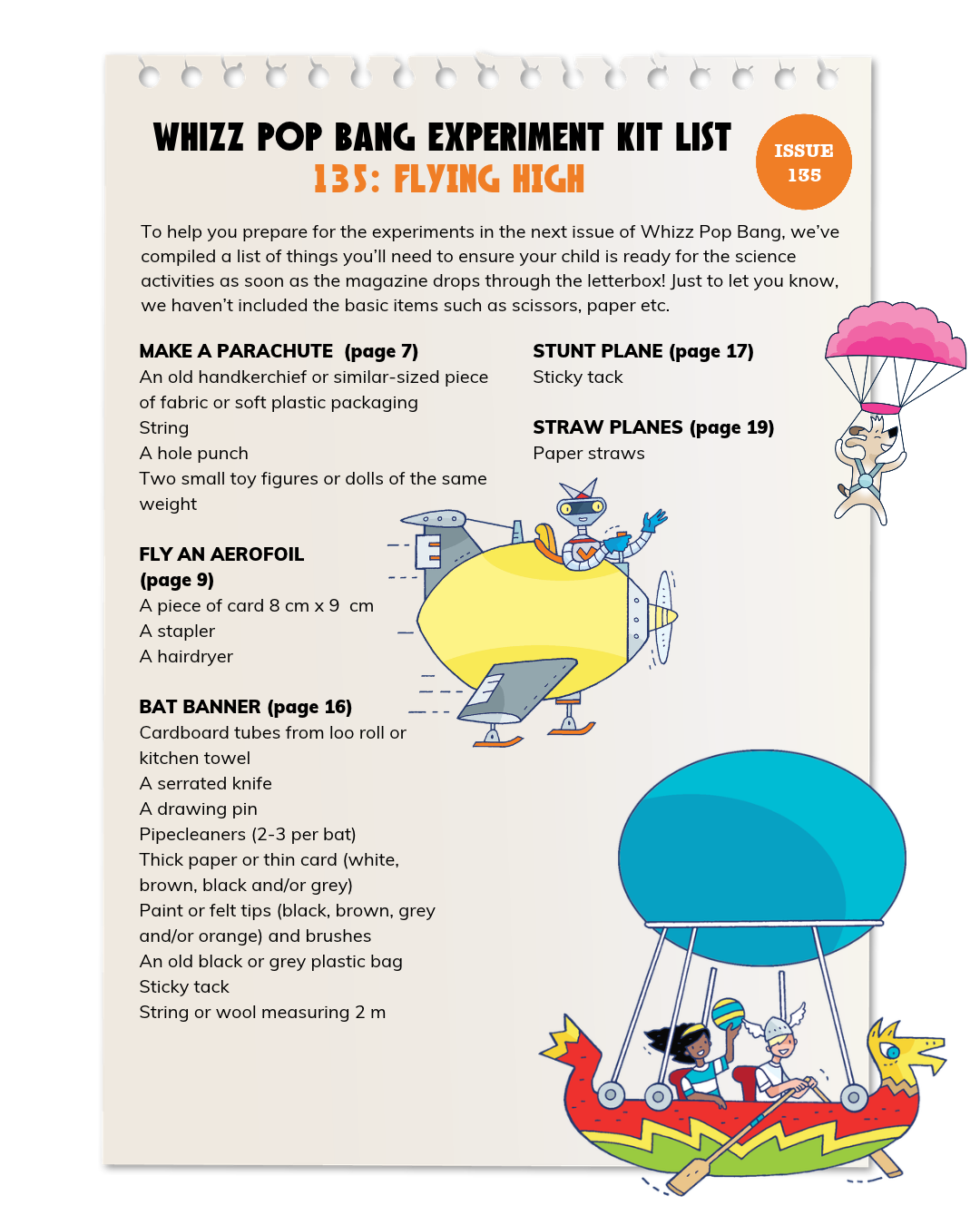
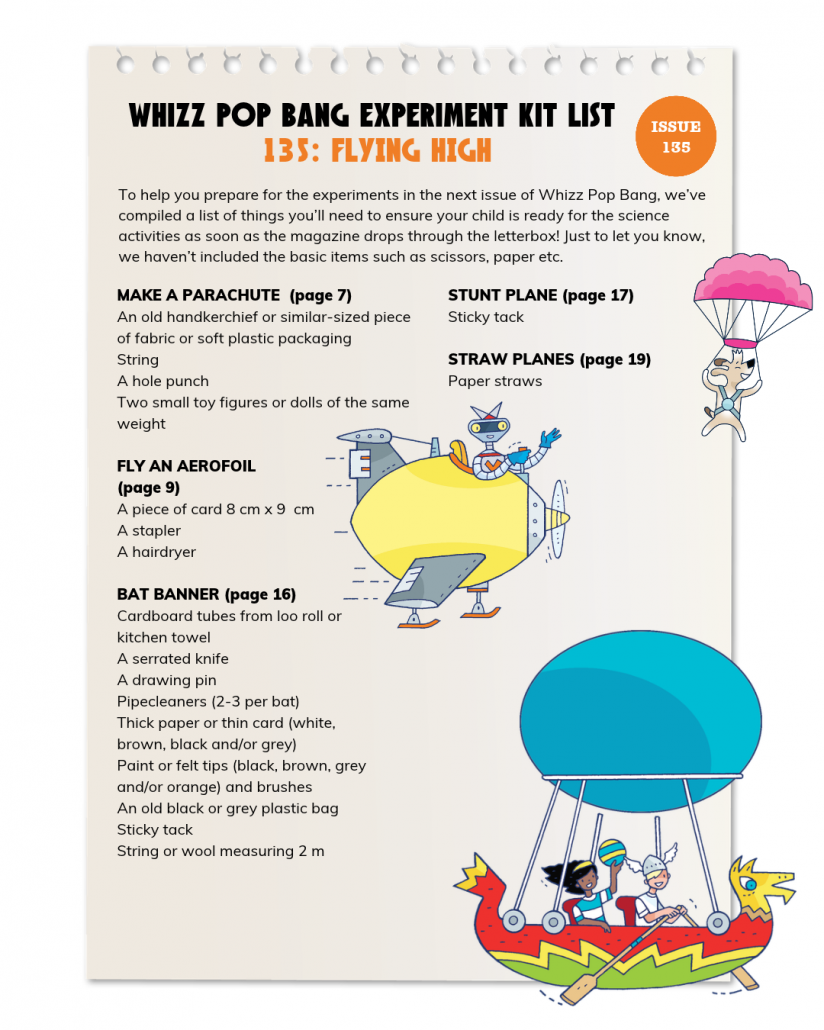
Here’s the list of bits and pieces you need to complete the activities this month. As ever, there’s so much science fun to be had, even if you don’t have every single thing on the list.
BUILD A FLOWER MODEL (page 7) A sharp green pencil Modelling clay A cocktail stick A cotton bud A ruler A green felt-tip pen
MAKE MULTI-COLOURED FLOWERS (page 9) Three white carnation flowers Two different colours of food colouring
GROW YOUR OWN (page 11) Seeds, seedlings or cuttings of chives, courgettes, mint, nasturtiums, violas or pinks
CHROMOTOGRAPHY FLOWERS (page 11) White paper towels (kitchen roll) Water soluable felt-tip pens Pipe cleaners A large coin
MAKE A SUNCATCHER (page 16) Flowers and leaves Newspaper or other paper Wax paper (or tracing paper or white baking paper) Sticky tack
Download a printable version of this kit list to stick on your fridge right here ⬇️
Cheltenham Science Festival returns from 2–7 June 2026 with six days of hands-on science, inspiring talks, free family activities and brilliant live shows for curious kids. Whether your child loves space, dinosaurs, inventions, gaming or experiments that fizz and bang, there’s something to spark their imagination.
For more details on the Cheltenham Science Festival and to book tickets, visit the official website.
Cheltenham Science Festival 2026 at a glance
📅 Dates: 2–7 June 2026 📍 Location: Imperial Gardens and venues across Cheltenham 👨👩👧 Best for ages: The whole family! Ideal for 4–12+ 🎟️ Free activities available: Yes 🧪 Includes: live science shows, workshops, interactive zones and hands-on experiments 🌦️ Good for drop-in visits: Yes
Big Bug Show – the science of insects, told by a poet and a musician. 7+
2. Free Things To Do at Cheltenham Science Festival
From science games to hands-on invention hubs, explore these free drop-in areas that are open all weekend:
Free family events at Cheltenham Science Festival on Saturday 6th June 2026
Free family events on Saturday – discover what’s on at the Jetstream in Imperial Gardens, Montpelier, Cheltenham on Saturday 6th June 2026
10.00–11.00am: Family Physics Singalong (All ages) Musical theatre and science collide in this fun family workshop with STEM musical theatre writers Helen Arney, Brian Mackenwells and Jenni Pinnock.
11.30am–12.00pm: Marvellous Mocktails (All ages) Expect demos, taste tests and fascinating science facts as Mark Miodownik explores the science behind fizzing, popping and banging drinks.
12.30–1.30pm: A STEM Musical: The Cambridge First All-Ladies Fire Brigade (All ages) A fiery musical adventure inspired by real-life women scientists studying at Girton College in the 1880s.
Free family events at Cheltenham Science Festival on Sunday 7th June 2026
Free family events on Sunday – discover what’s on at the Jetstream in Imperial Gardens, Montpelier, Cheltenham on Sunday 7th June 2026
Sunday 7th June 2026
10.30–11.00am: From One Tiny Cell (Age 7+) FameLab winner Tammy Lee explores how a single tiny cell grows into a human being through interactive challenges and fascinating science.
11.45am–12.30pm: Science Stinks! (All ages) Discover the disgusting, surprising and hilarious science of smells in this fun family show.
1.00–2.00pm: The Next Generation of FameLab Watch talented young science communicators bring science to life with exciting talks full of energy and big ideas.
2.30–3.30pm: The Future of Science Three global FameLab storytellers take to the stage for an inspiring afternoon of science, storytelling and discovery.
For engineers-in-training: ⚒️ Tinker in the MakerShack
For curious thinkers: 🧠 Dive into discovery in the Discover Zone
For gamers: 🕹️ See the science behind the games in The Arcade
For gadget fans: ✈️ Explore cutting-edge tech in The Flight Deck
Other UK Science Festivals to Explore
Can’t make it to Cheltenham? Here are other science festivals across the UK that offer family-friendly activities:
The Big Bang Fair – 9th – 11th June 2026, Birmingham. This event showcases STEM careers and interactive exhibits for young people.
Edinburgh Science Festival – Offers a diverse programme of activities, including experiments, shows, and discussions suitable for all ages. The next festival will be held in 2027 – check their site for dates of the next Edinburgh Science Festival.
Oxford Science and Ideas Festival – Combines science with arts and culture, providing a unique experience for families. The next festival will be held in 2027 – check their site for dates of the next Oxford Science and Ideas Festival.
Norwich Science Festival The next Norwich Science Festival will be held on 12 – 18 February 2027. Visit their site for more information.
Note: Please check each festival’s official website for the latest information on dates and programmes.
Brace yourself… this one is not for the squeamish.
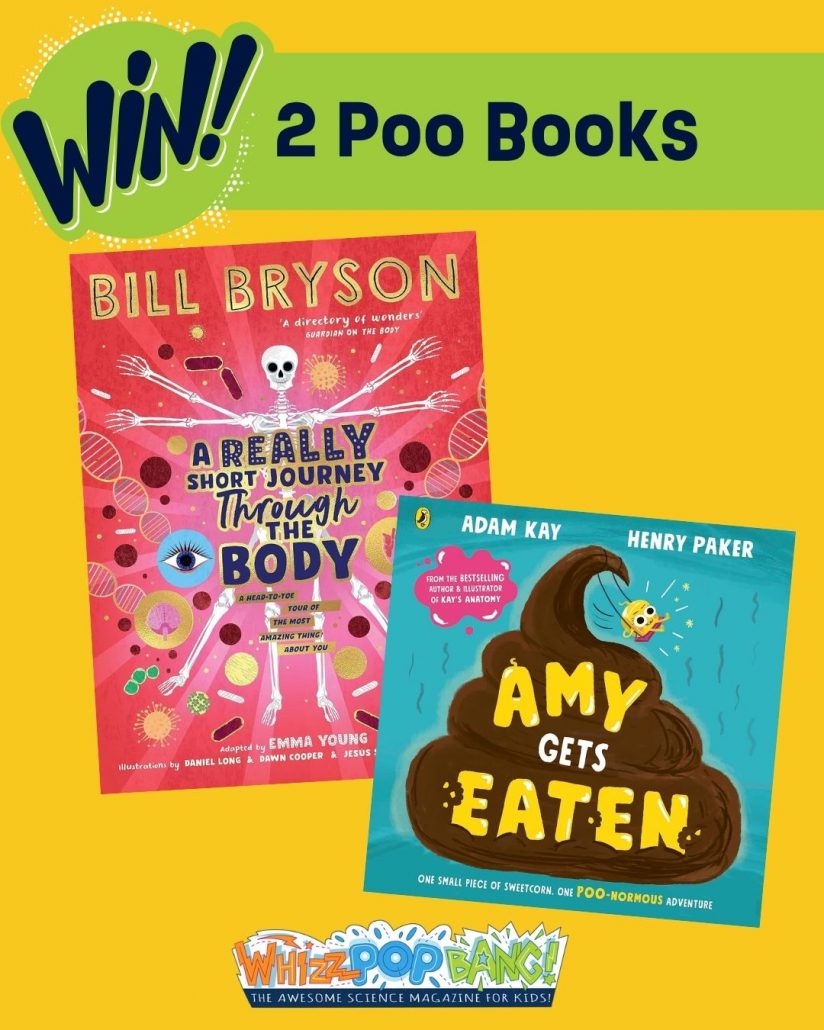
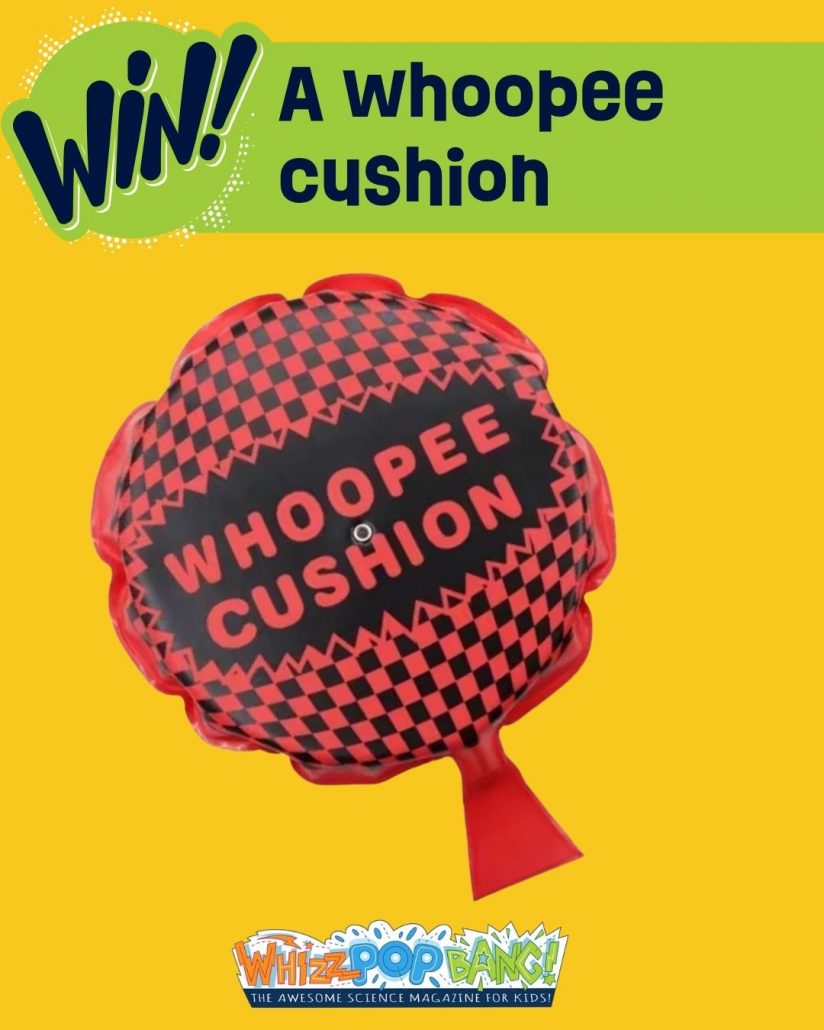
To celebrate the gloriously gross new Whizz Pop Bang: POO! issue, we’ve put together the ultimate bundle of squishy, stretchy, slightly disgusting fun.
And yes… we really mean it when we say…
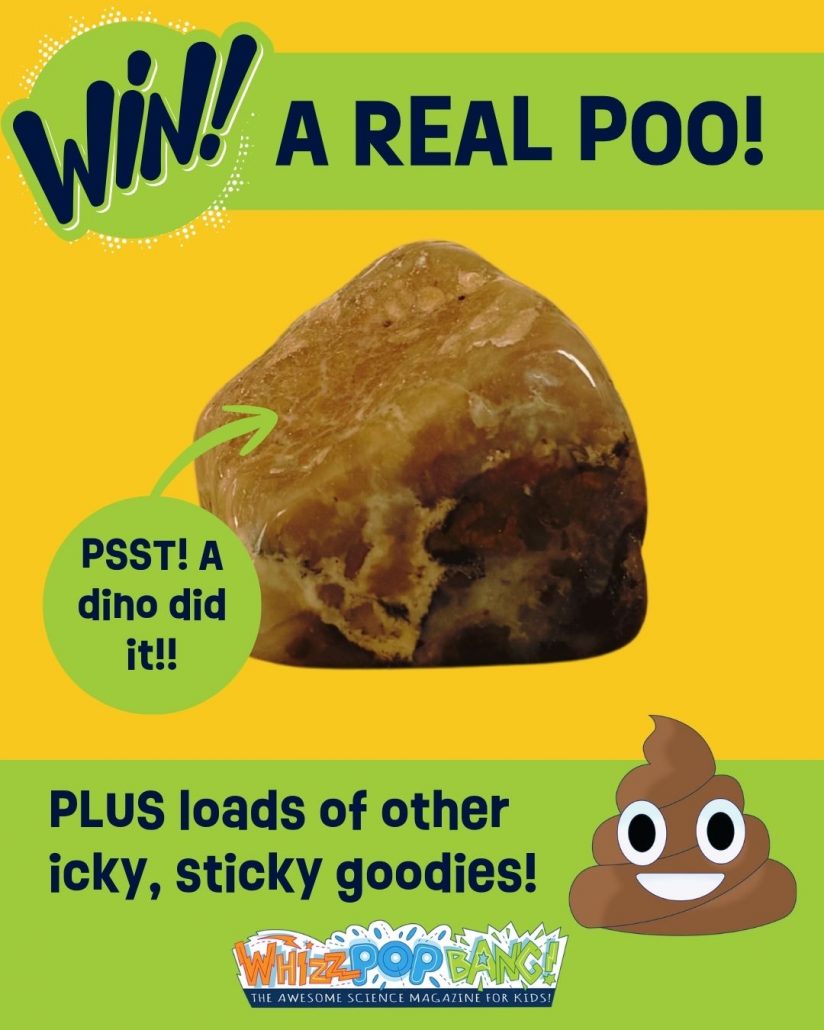
🤢 You could WIN a real poo!
(OK, it’s a fossilised dinosaur poo – also known as a coprolite – but still. That’s pretty amazing, right?)
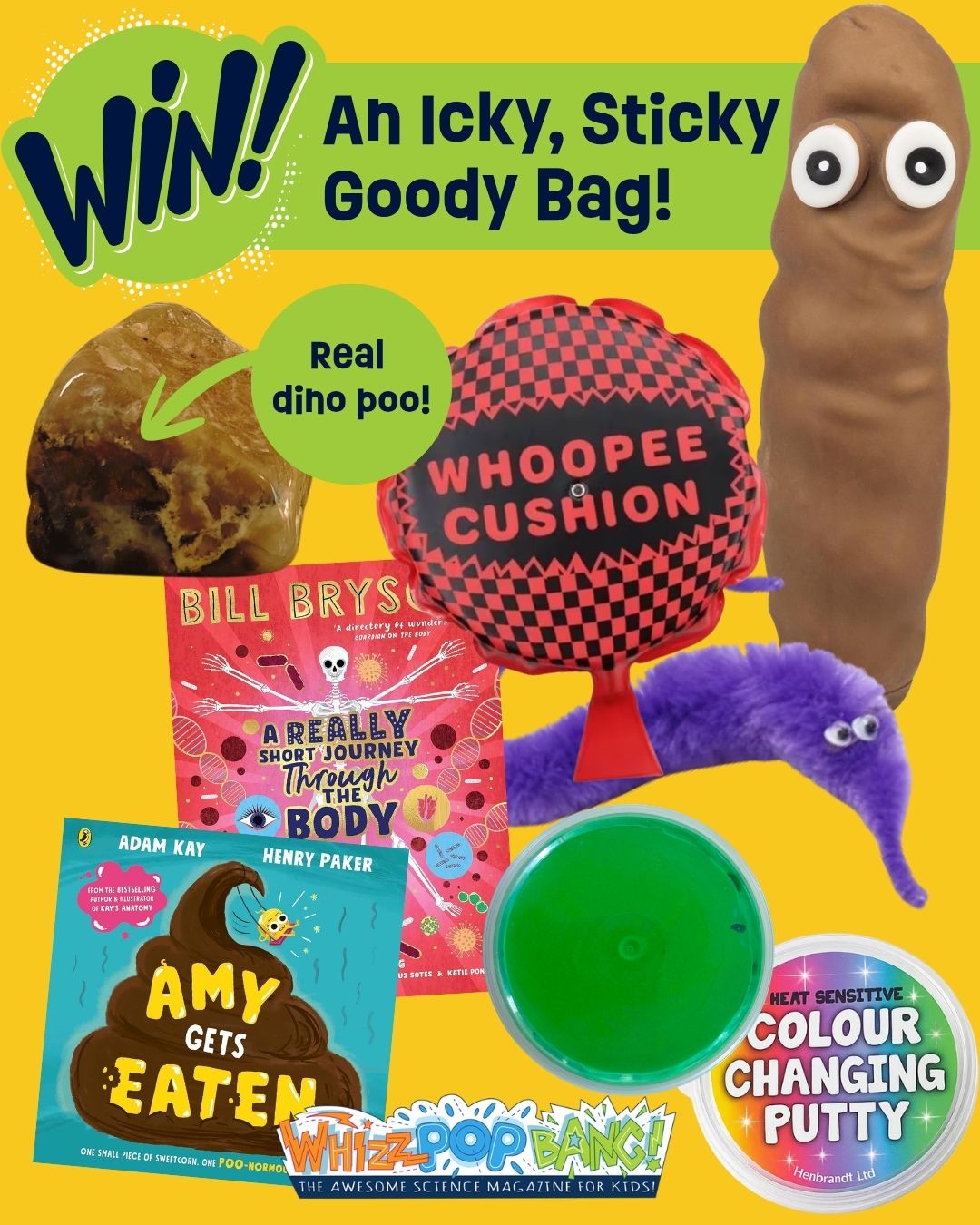
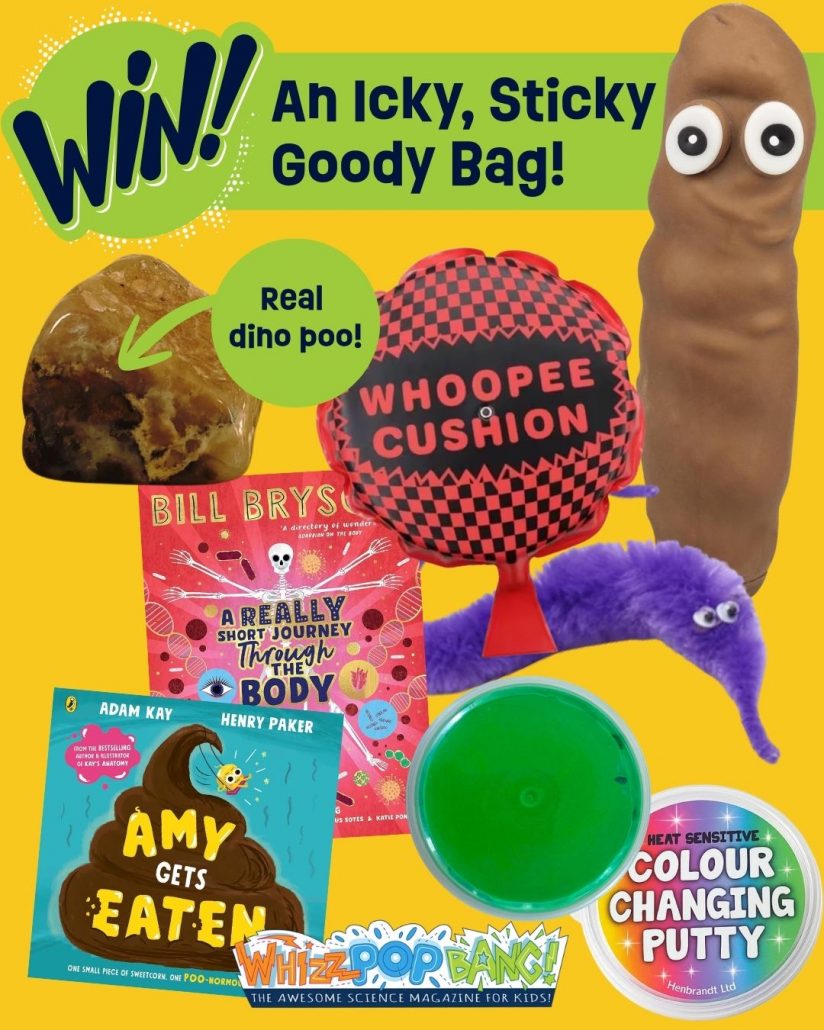
🎁 What’s in the Icky Sticky Goody Bag?
One lucky winner will get their hands on this brilliantly bonkers bundle:
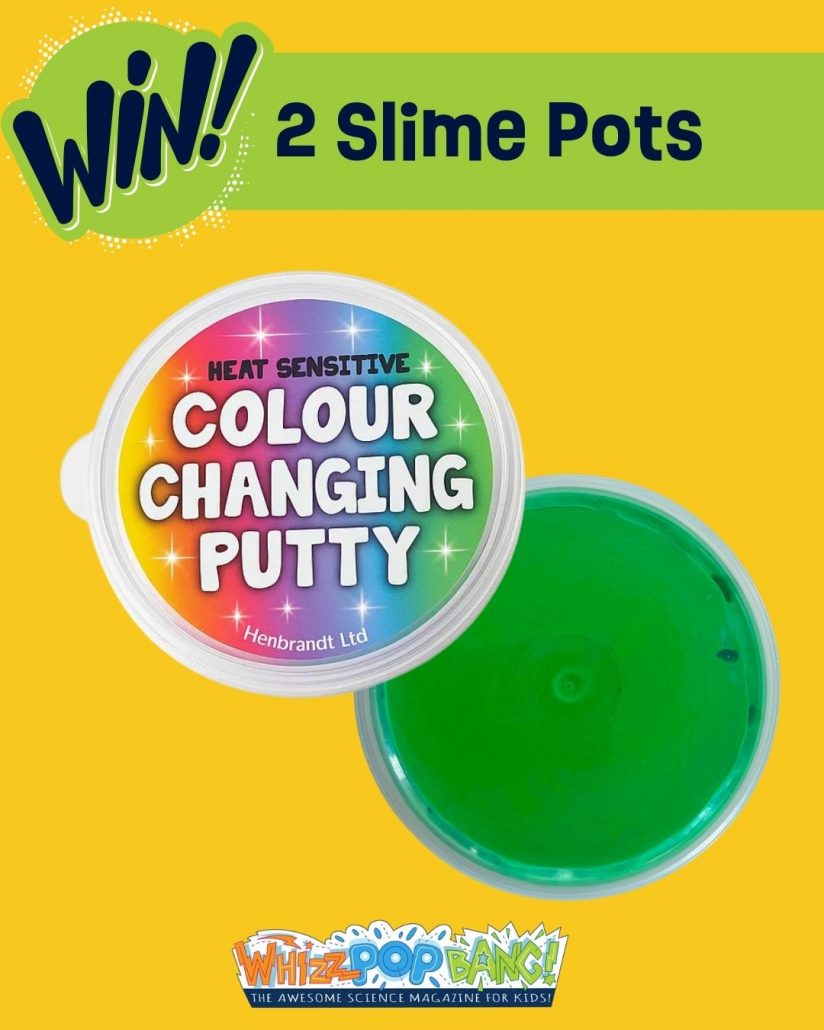
🟢 Two pots of slime – one green and gooey, one colour-changing
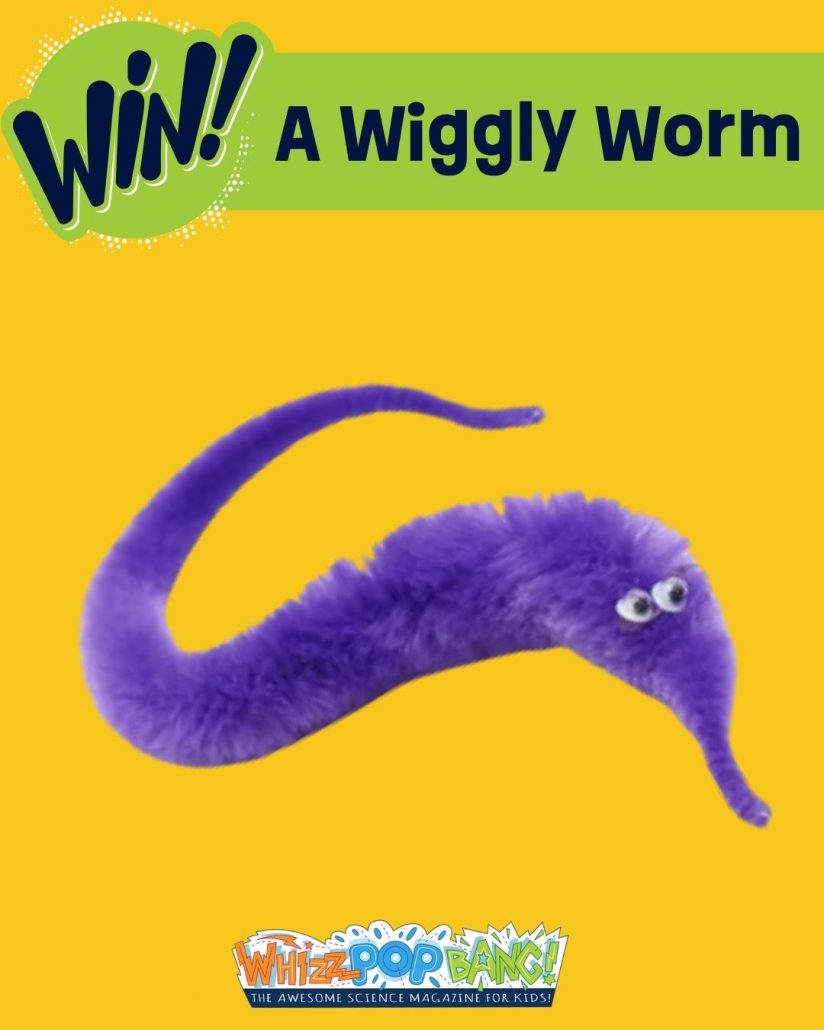
🐛 A wiggly worm toy
It’s squishy. It’s silly. It’s a bit gross. And kids are going to absolutely LOVE it.
🧪 Why all the poo?
Because poo is seriously scientific.
Inside your body, digestion is hard at work breaking down food, absorbing nutrients and producing waste. Animal poo can tell scientists incredible stories, from what dinosaurs ate to how ecosystems worked millions of years ago.
So while this bundle might seem a bit ridiculous, it’s actually packed with curiosity, learning and laugh-out-loud fun.
🏆 How to enter
Entering is easy! Simply answer this question to be in with a chance of winning:
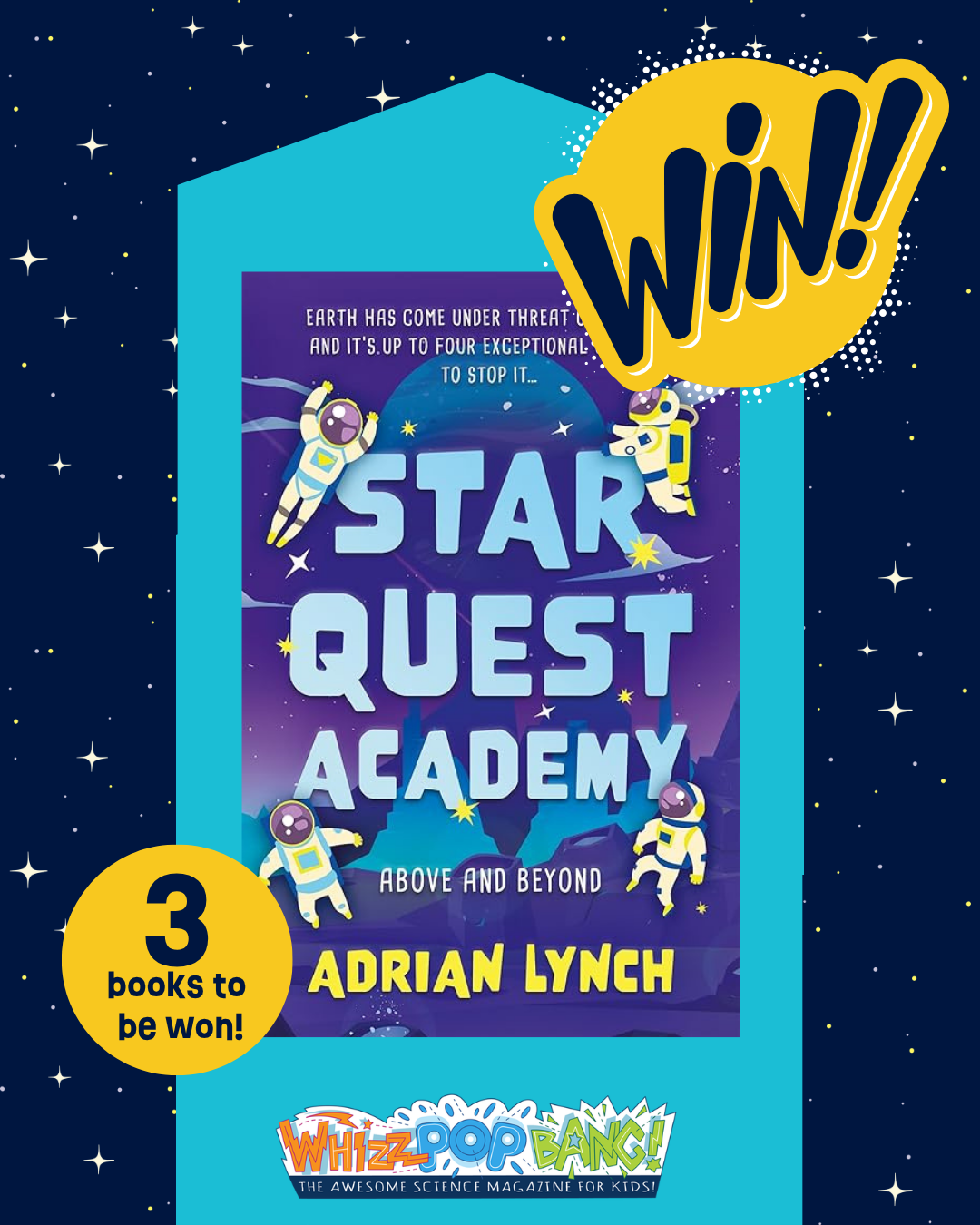
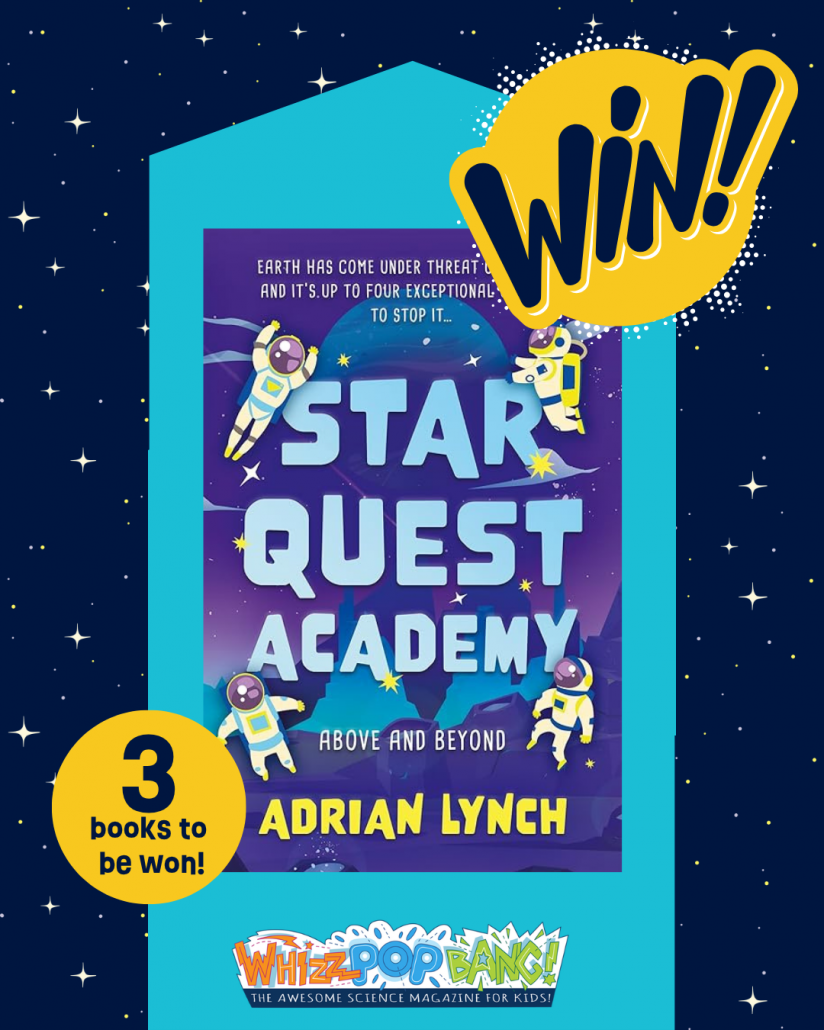
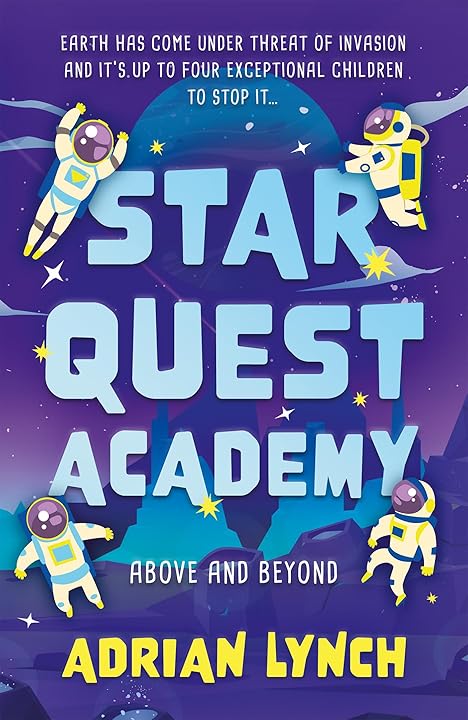
Perfect for curious readers who love space, science fiction and fast-paced stories, this is a book they won’t want to put down!
🚀 About the book
Step into a universe of adventure at Star Quest Academy, where young recruits are trained to explore the stars and take on daring missions beyond Earth.
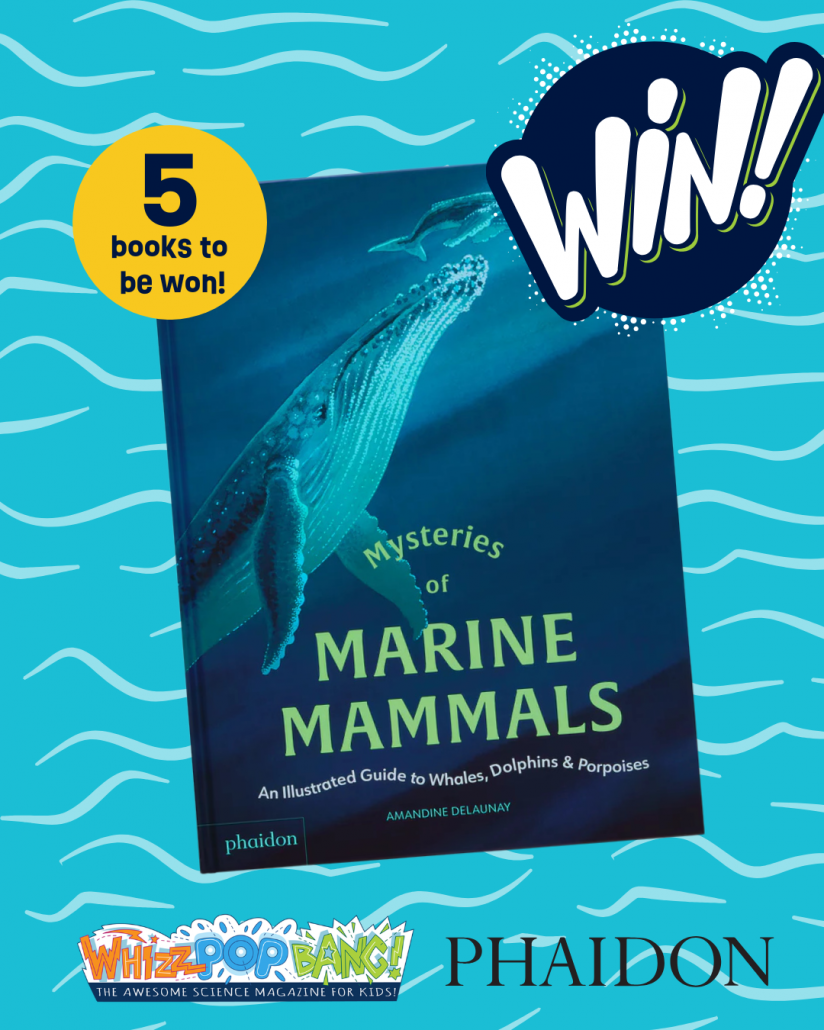
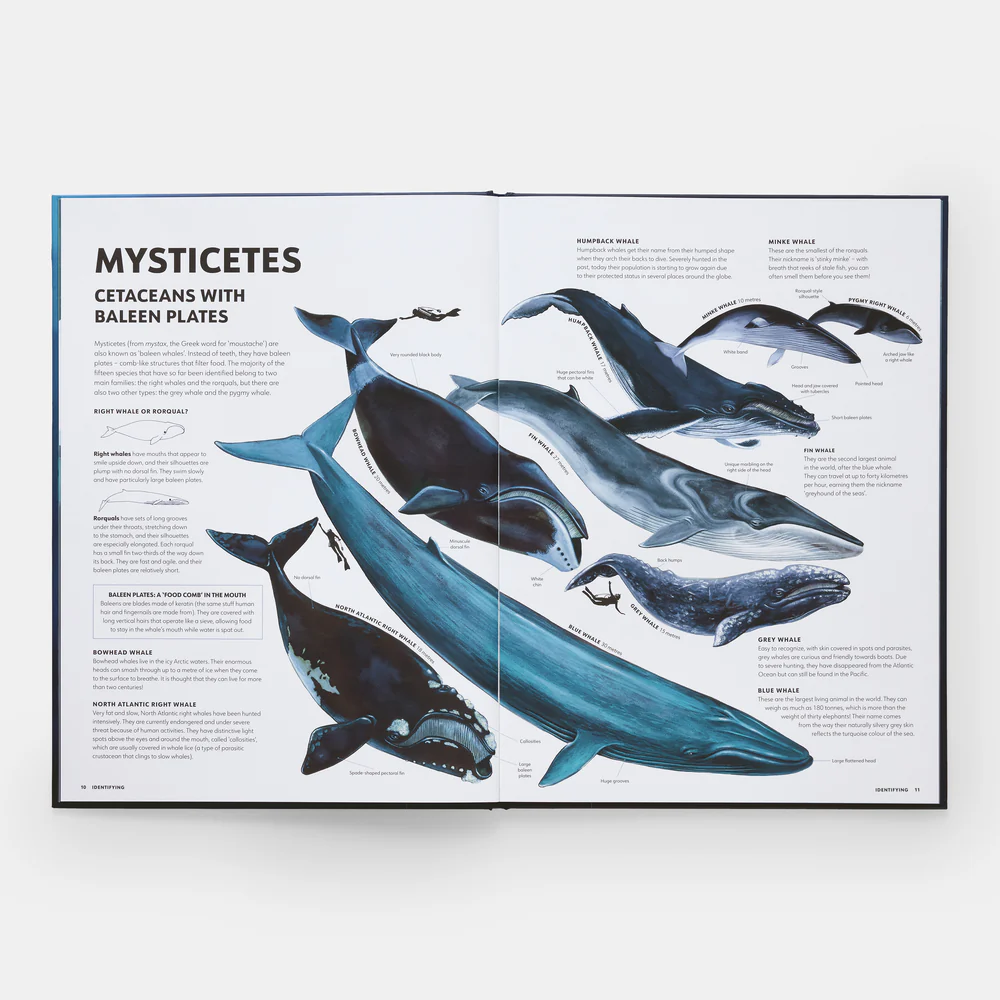
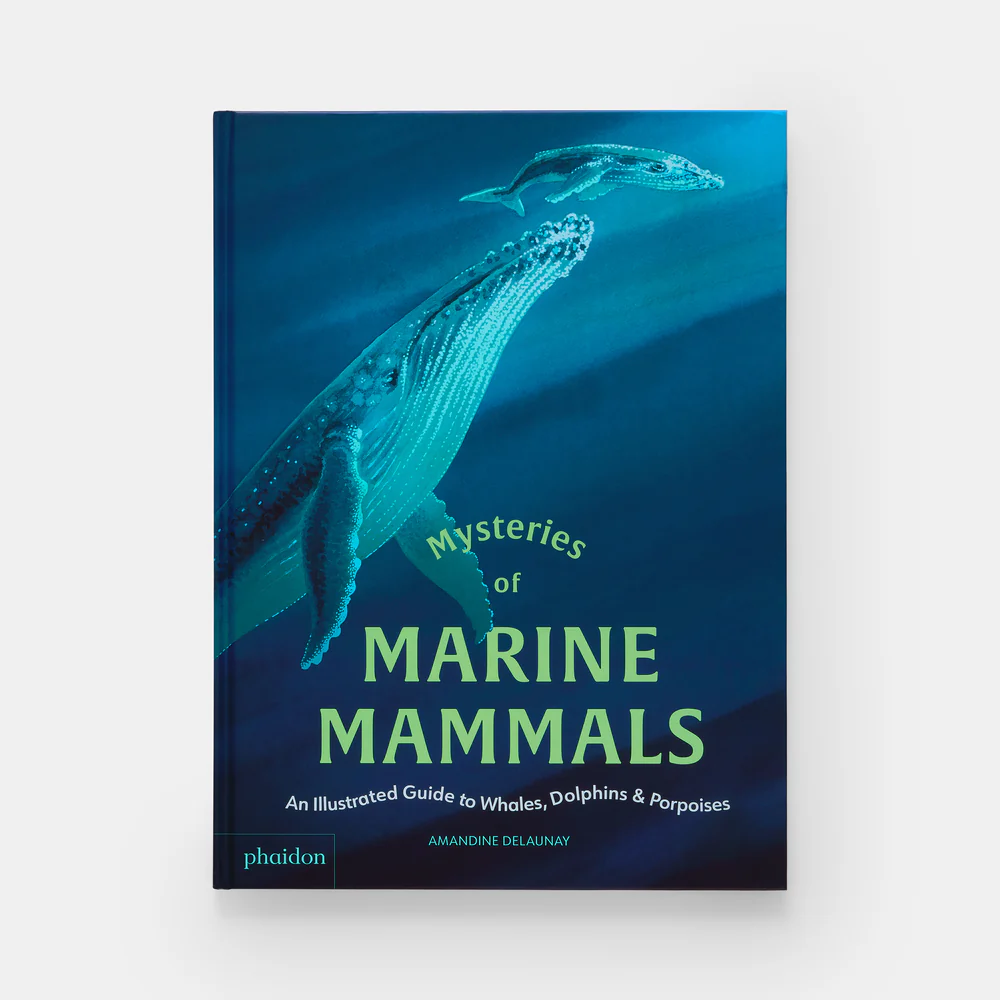
Love whales, dolphins and life beneath the waves? Then you’re in for a treat because this month’s edition of Whizz Pop Bang, Undersea Explorers, is all about the ocean. But that’s not all… we’re also giving our fans the chance to win one of five copies of Mysteries of Marine Mammals by Amandine Delauney – a beautifully illustrated guide to whales, dolphins and porpoises.
What is Mysteries of Marine Mammals about?
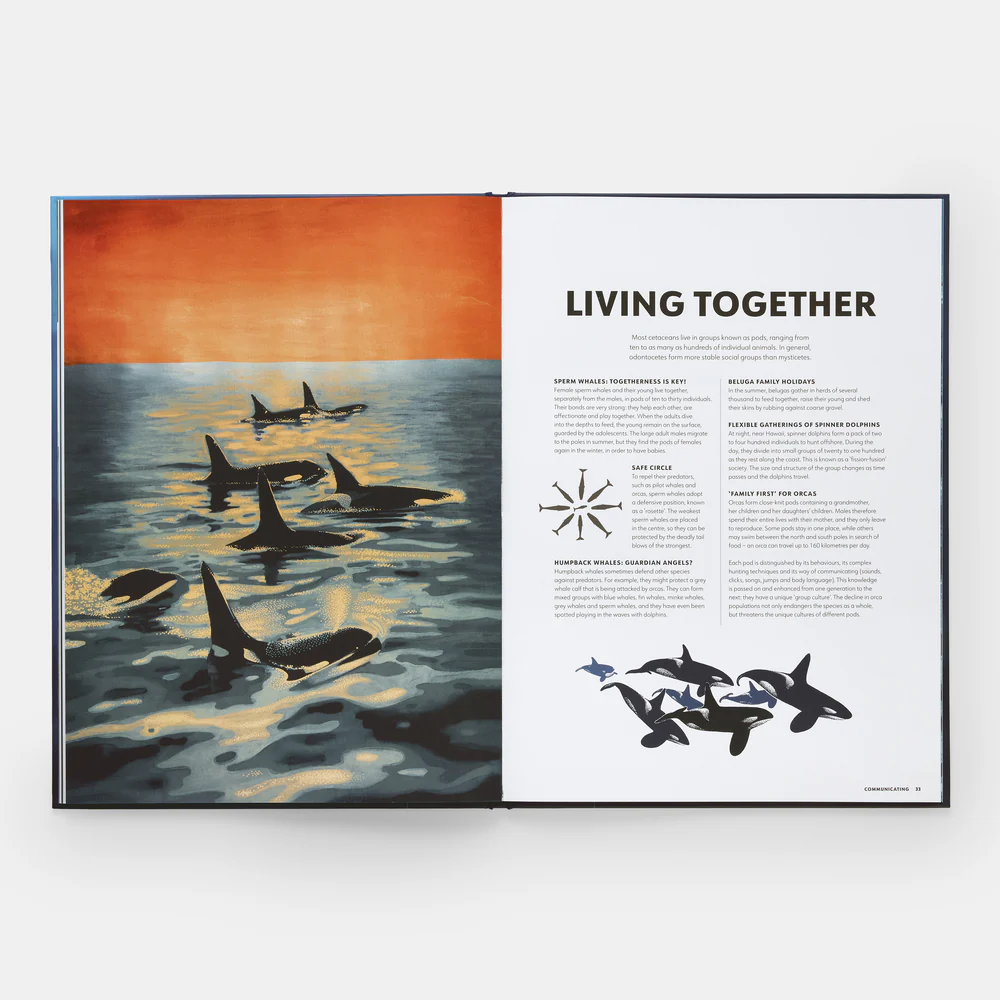
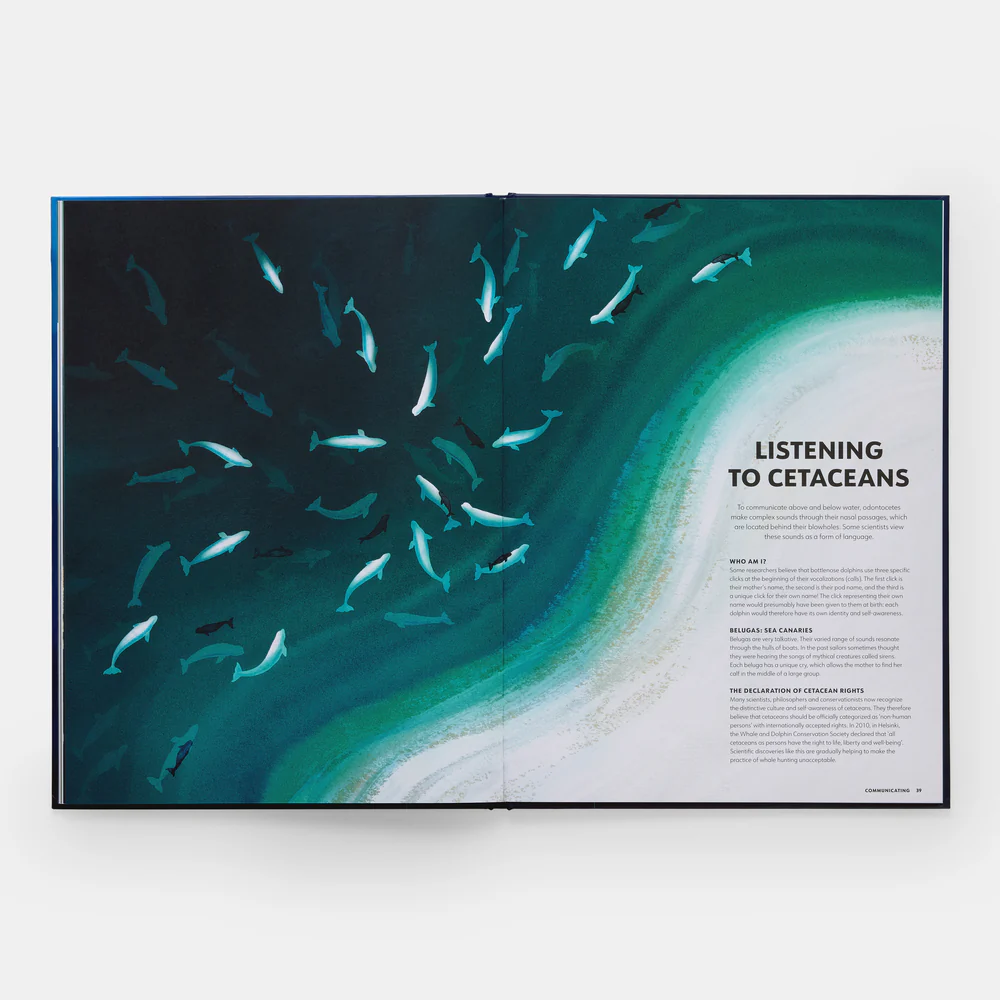
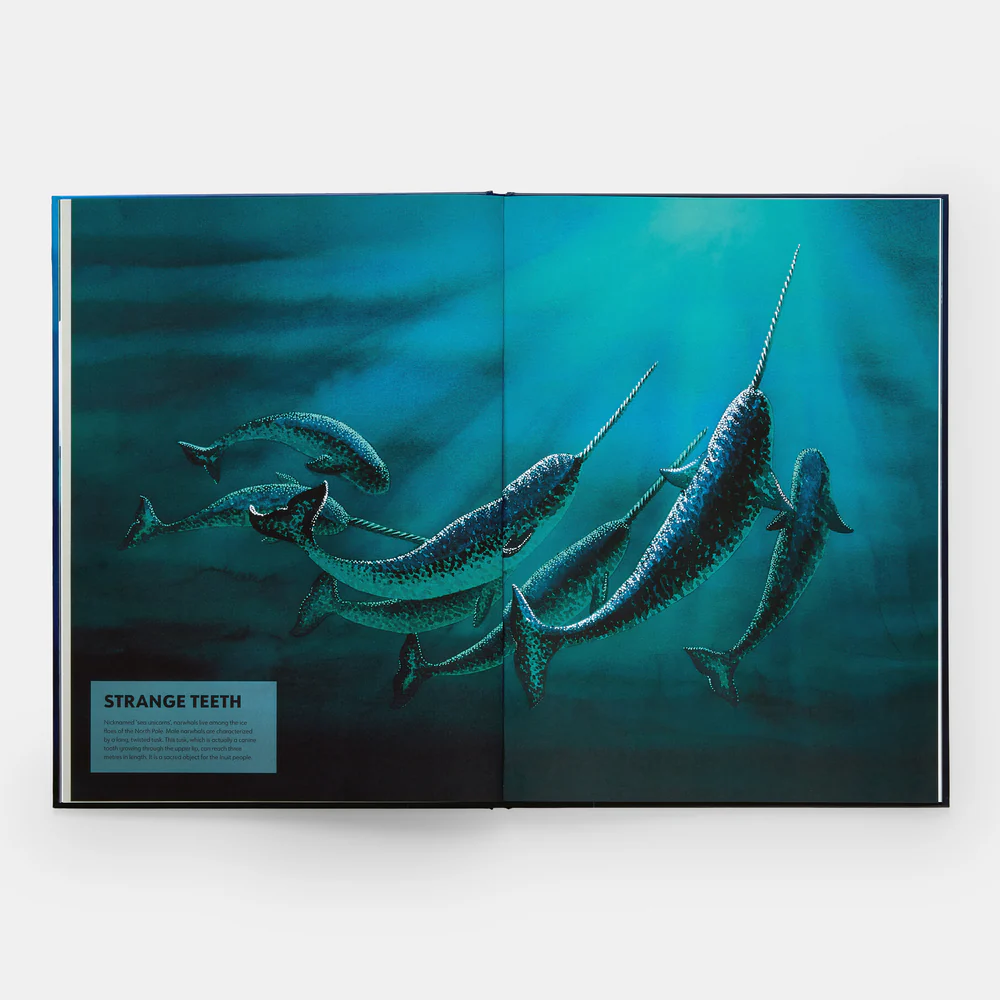
Written and illustrated by Amandine Delaunay, Mysteries of Marine Mammals is a stunningly illustrated exploration of the ocean’s most fascinating mammals.
Inside, young readers will discover:
🐋 How whales communicate across vast ocean distances
🐬 The differences between dolphins and porpoises
🌊 How marine mammals survive in icy waters
🧠 The surprising intelligence of ocean giants
🫁 Why mammals breathe air – even underwater ones
It’s a brilliant example of a science book for children that combines real biology with engaging artwork and accessible explanations.
Who is this book suitable for? This book is ideal for children aged around 7 to 11 who enjoy ocean life, animals and science.
Do I need to be a Whizz Pop Bang subscriber to enter? No – this competition is open to all readers.
When does the competition run? The giveaway runs from 1 March to 31 March 2026.
Good luck, Undersea Explorers!
We love sharing science books for kids that inspire curiosity about the natural world. Whether you’re fascinated by breaching whales or deep-diving dolphins, this giveaway is your chance to explore the ocean’s most remarkable mammals.
Tim Peake spent 186 days on the International Space Station between 15 December 2015 and 18 June 2016 and has shared some of his amazing experiences with Whizz Pop Bang magazine. We chatted to him about what it’s like to live in space!
European Space Agency astronaut, Tim Peake.
How did you feel when you were preparing to go into space?
“I had so many feelings! On the one hand, there was a huge amount of excitement and adrenaline. The trip was a culmination of years of work and effort, so I was really looking forward to it. I was a little bit apprehensive as well – obviously there’s a rocket launch to go through, and then all eyes are on you. The eyes of the agency, the eyes of your crew mates, the eyes of the nation watching! There are times when you just have to step up to the plate and perform.
Catching a visiting cargo vehicle is a one-person job: it is your responsibility to connect an entire space station to an entire cargo vehicle, and nobody else can help with that. These tasks are very, very high-pressure!
I felt that pressure – as sports people do when they have to perform – when I went out on the space walk. So I was definitely apprehensive, but the majority of my feelings were excitement and adrenaline. Being up there on the space station is such a privilege and everyone supports you to try and be the best that you can be.”
What’s it like looking at Earth from space?
“I just loved looking down at Kamchatka on the east coast of Russia, for example, and seeing a volcano smoking away. I’d think, ‘Nobody but me knows that volcano is erupting,’ because there literally are no humans within 2000 square miles of that location. It’s just wonderful that you can visualise the entire planet having been around it about 3000 times.
There’s nowhere on Earth that I don’t know now. Although clearly, I haven’t visited every country, I’ve got a different perspective of the planet.
It’s very serene in space. It’s a beautiful environment to be in; weightlessness, to be floating, to be looking down, just gracefully passing over the Earth without any noise, no vibration. It’s a beautiful, beautiful feeling.”
Did you look out for aliens!?
“Absolutely! The funny thing about looking out away from Earth is that in the daytime, you just see the blackness of space. It’s a very strange black – the blackest black you’ll ever see. Here on Earth we never really see black like this, because there’s always ambient light around.
In space – wow! You feel like you’re falling into the void when you look out at the blackness of space. And of course, there are no stars because the Sun is so bright that it blinds out the light of the other stars. You can only see this black abyss.
At night, when we are in the Earth’s shadow, all the stars come out. It’s beautiful to look the other direction: you can see 100 billion stars making up the Milky Way with no light pollution. The interesting thing is, you can’t see other satellites which you can see clearly from Earth – I look up at the night sky here, and I’m always seeing satellites going overhead. But in space, because we’re travelling so fast, it’s very, very hard to see another satellite that’s also travelling very fast with the naked eye. So we don’t see lights coming towards us in space.”
What’s bedtime like in space?
“Sleeping in weightlessness is lovely once you get used to it. It’s a bit tough to begin with, because your body doesn’t know to go to sleep. Here on Earth, every day of our lives we lie down at bedtime, rest our heads on pillows, and these actions are such strong triggers to make us fall asleep. When you don’t have those triggers, you float around all day, you float into your crew quarter, you zip up a sleeping bag, you can switch off the lights, you can put in some earplugs in but your body says, ‘What now?’ Once you get used to it and your body can fall asleep, wow, it’s a lovely sleep. There are no pressure points, no tossing and turning, no restlessness and you wake up completely relaxed.
We only need six hours’ sleep maximum on the space station because the quality of sleep is so good.
I used to like to strap my sleeping bag loosely using tie wraps, just enough to allow me to float around a little bit – not so much that I’d bang my head on the roof, but enough to enjoy that floating experience.”
How do you eat on the ISS?
“You get very unpopular with your crew mates if you open a packet of crisps or something like that!
Crumbs go everywhere, even in people’s eyes, all week long – so we try and avoid that.
I had bags of pistachio nuts, already shelled, but they were a treat that were sent up in care packages every now and again. You just had to be careful about how you eat that kind of thing. But yes, you don’t really want to have crumbs in the space station!”
This beautifully illustrated book is a children’s guide to the science, stories and symbolism of stars, exploring their role across cultures, histories and scientific discovery. Bursting with facts, myths and cosmic wonder, Wish Upon a Star is perfect for curious young minds who want to understand how stars shape our world and our imagination.
✨ Learn about different types of stars, constellations and galaxies 🧭 Discover how stars have been used for navigation across the centuries 🎨 Explore how stars have inspired art, stories and mythology around the world 🔭 Find out how scientists study stars and what they reveal about the universe
Whether your child is into science, space, history or storytelling, this magical journey through the cosmos is a brilliant companion to our space-themed issues of Whizz Pop Bang!
How to enter
To win one of five copies of Wish Upon a Star, simply answer this question in the comments:
Which of these is a constellation? a) The Dolphin b) The Spoon c) The Big Dipper
Wish Upon a Star makes a perfect gift for any child who loves space, storytelling or science – and it’s the ideal companion to Whizz Pop Bang: Rocket RIders. Not yet a subscriber? Start your subscription here and blast off into a universe of fun!
The fun begins as soon as you open the box. Press out then slot together 61 cardboard parts (no glue required!), add two elastic bands and you’ll soon have one fully working pinball machine. The build should take around 60 minutes and is suitable for engineers-in-training aged 8 and up.
Once it’s ready, load up the five swirly glass marbles and see if you can make them fly up the ramp, through the bumpers and round the vortex cone! Challenge your family to see who can get a high score on your very own DIY pinball machine!
This eco-friendly STEM kit is: ✅ Designed for ages 8+ ✅ Mess-free and fun to build ✅ Perfect for developing dexterity and reflex skills ✅ Made in the UK using high-quality sustainable cardboard
Whether you’re building it as a family project or battling it out for the best score, you’ll love every minute.
How to enter
To be in with a chance of winning one Build Your Own Pinball Machine kit, simply answer this question in the comments below:
Which of the below is a category of energy?
a) Kimchi b) Kindred c) Kinetic
This competition closes at midnight on 30th September 2025. One lucky winner will be chosen at random from all correct entries. For full terms and conditions, click here.
We’ve got an amazing array of books to give away, perfect for curious children who love bugs, space, aliens and saving the planet! Thank you to our friends at Flying Eye Books for these gorgeous prizes!
Three lucky winners will each receive a set of four fantastic, fact-packed books that blend science, adventure and BIG questions about the universe. Here’s what’s up for grabs…
🪐 Cosmo Park by Madeleine Finlay and Tom Dearie Jump aboard a hover-buggy and zoom through a cosmic theme park in this vibrant comic-style book! Learn all about black holes, galaxies and the freezing end of the universe – all wrapped up in colourful illustrations and mind-blowing facts.
👾 The Unexplained: UFOs by Adam Allsuch Boardman Are we alone in the universe? Explore the mysterious world of UFOs in this graphic guide packed with alien sightings, strange encounters, and fascinating theories. Perfect for kids with big imaginations and even bigger questions.
How to enter
To be in with a chance of winning, just answer this question in the comments:
Which one of the below is not a type of beetle?
A) Rose chafer B) Ninety-nine-spot beetle C) Rainbow leaf beetle
Find out how to draw Dash the firefly from The Beastie Bros books with this simple drawing tutorial!
Have you read Beastie Bros: the Cabbage Juice Crime by David O’Connell? It stars an unlikely crime-solving duo – Dash the firefly and Dribble the snail. Keep scrolling to find out how to draw Dash the firefly!
If you’re interested in minibeasts, creepy crawlies and all sorts of insects, you’ll love Whizz Pop Bang: Minibeast Safari! Investigate the science of insects as you make an insect pooter, build a bug hotel, craft a balancing butterfly, meet jungle creepy crawlies and more. Plus there’s a competition to win Beastie Bros: The Cabbage Juice Crime by David O’Connell. You can find it in our shop now!